

In this article
- The Silent Shutdown: Why 2026 Threats Target IT, Not Machines
- 1. The Myth of the "Exotic" Industrial Hack
- 2. The Explosive 5.5x Growth of Ransomware Claims
- 3. Why Manufacturing is the Ultimate Pressure Point
- 4. The Industry’s Massive Visibility Blind Spot
- 5. The "Boring" Vulnerabilities Winning the War
- Conclusion: Beyond the Breach Blast Radius
Industrial cyber risk is now production risk. See how blind spots in risk visibility drive modern factory downtime.
In this article, we confront the sobering reality of industrial cybersecurity breaches.
The Silent Shutdown: Why 2026 Threats Target IT, Not Machines
Imagine the sudden, heavy silence of a factory floor where the assembly line has ground to a halt. You check the gears, the motors, and the power supply—everything is mechanically perfect. There is no "high-tech" saboteur rewriting the logic of your controllers. Instead, the production line is dead because a server in a climate-controlled data center miles away—a system responsible for simple identity verification or production scheduling—has gone dark.
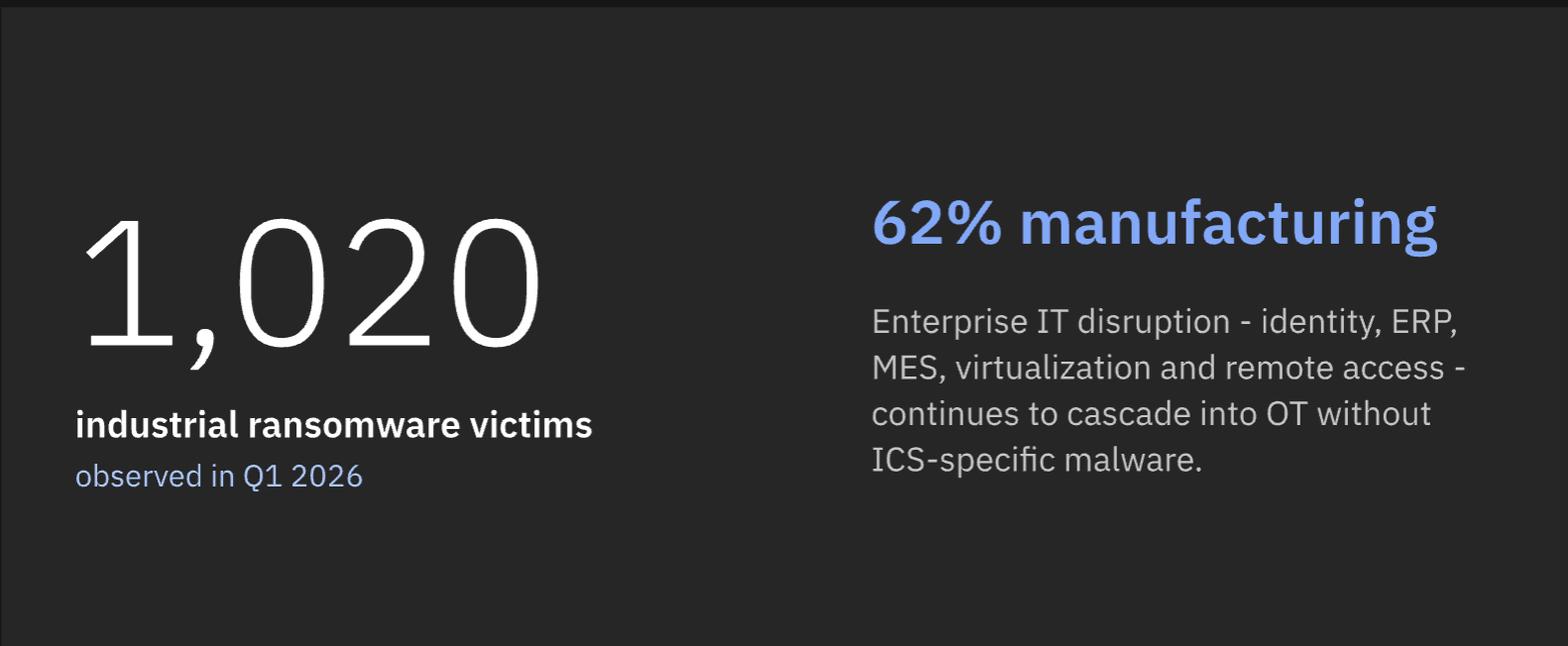
We have officially moved past the era of the "exotic" industrial hack. Today, industrial disruption is rarely about a targeted strike on a machine; it is the result of ordinary IT failures cascading into the heart of operations. For the modern plant manager, the math of industrial extortion has shifted from a rare nuisance to a recurring line item in the budget.
1. The Myth of the "Exotic" Industrial Hack
There is a persistent strain of security theater in our industry that obsesses over specialized, "ICS-specific" malware designed to flip bits in a PLC. The 2026 data shatters this myth. Attackers have realized they don't need to touch a machine to stop you from making products.
The latest findings show that disruption almost always cascades from the enterprise layer. When identity services, Enterprise Resource Planning (ERP) software, or Manufacturing Execution Systems (MES) are compromised, the operational boundary collapses. In fact, 70% of OT incidents now originate in IT environments.
Ransomware does not need to 'hack the PLC' to stop the line.
Organizations overlook the vulnerability of their infrastructure.
For instance, the targeting of virtualization—the very backbone of modern production environments—has jumped from 29% to 43% in just one year. The most dangerous gap isn't a lack of specialized firewalls; it is the uncertainty regarding which IT assets are connected to the floor and whether they are actually recoverable.
2. The Explosive 5.5x Growth of Ransomware Claims
Industrial cyber threats are no longer episodic events that strike the unlucky few. They have become a sustained operating condition. The scale of this escalation is staggering:
- 2022: 605 industrial victims.
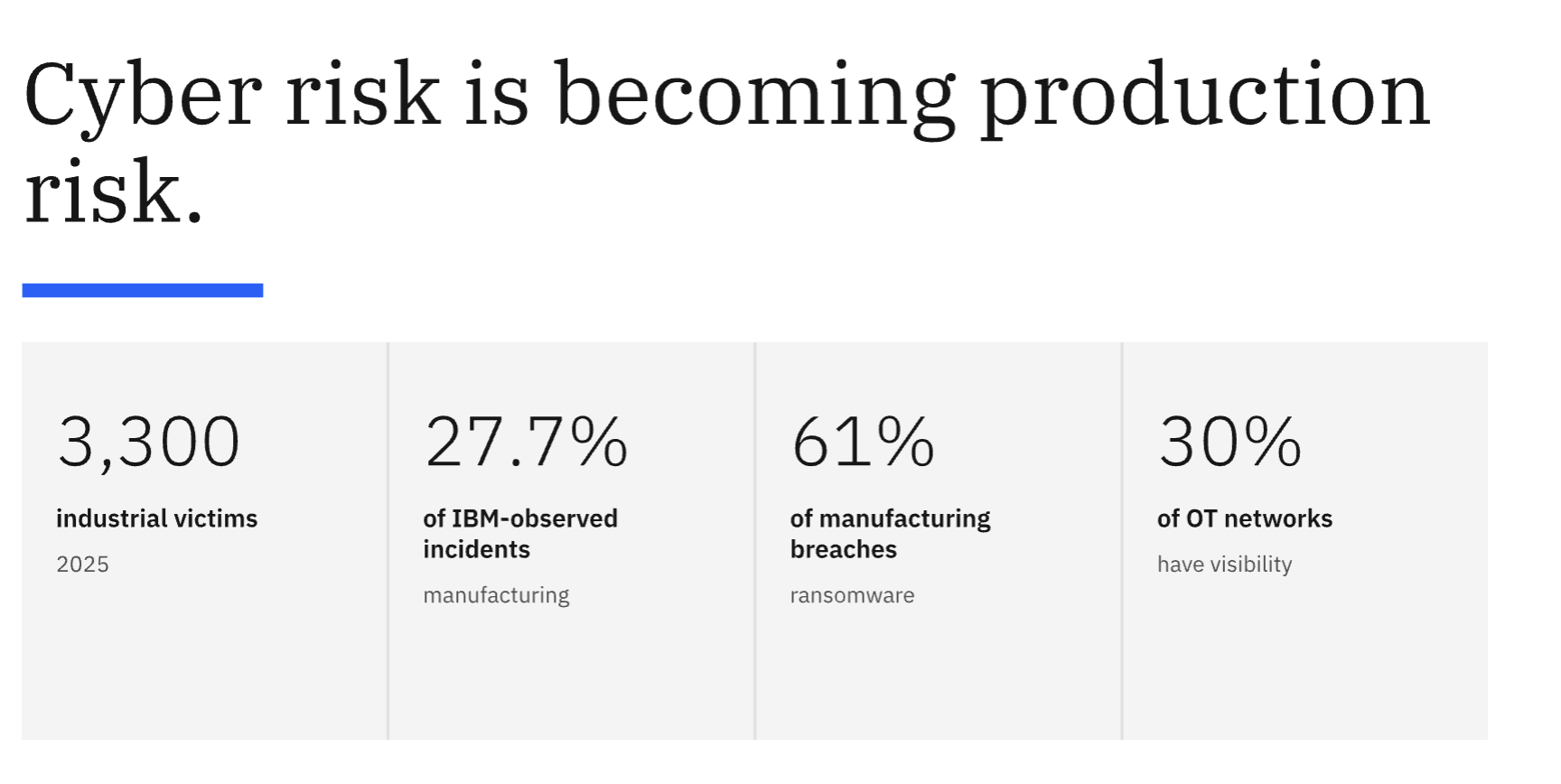
- 2025: 3,300 industrial victims.
- Q1 2026: 1,020 victims observed in just three months.
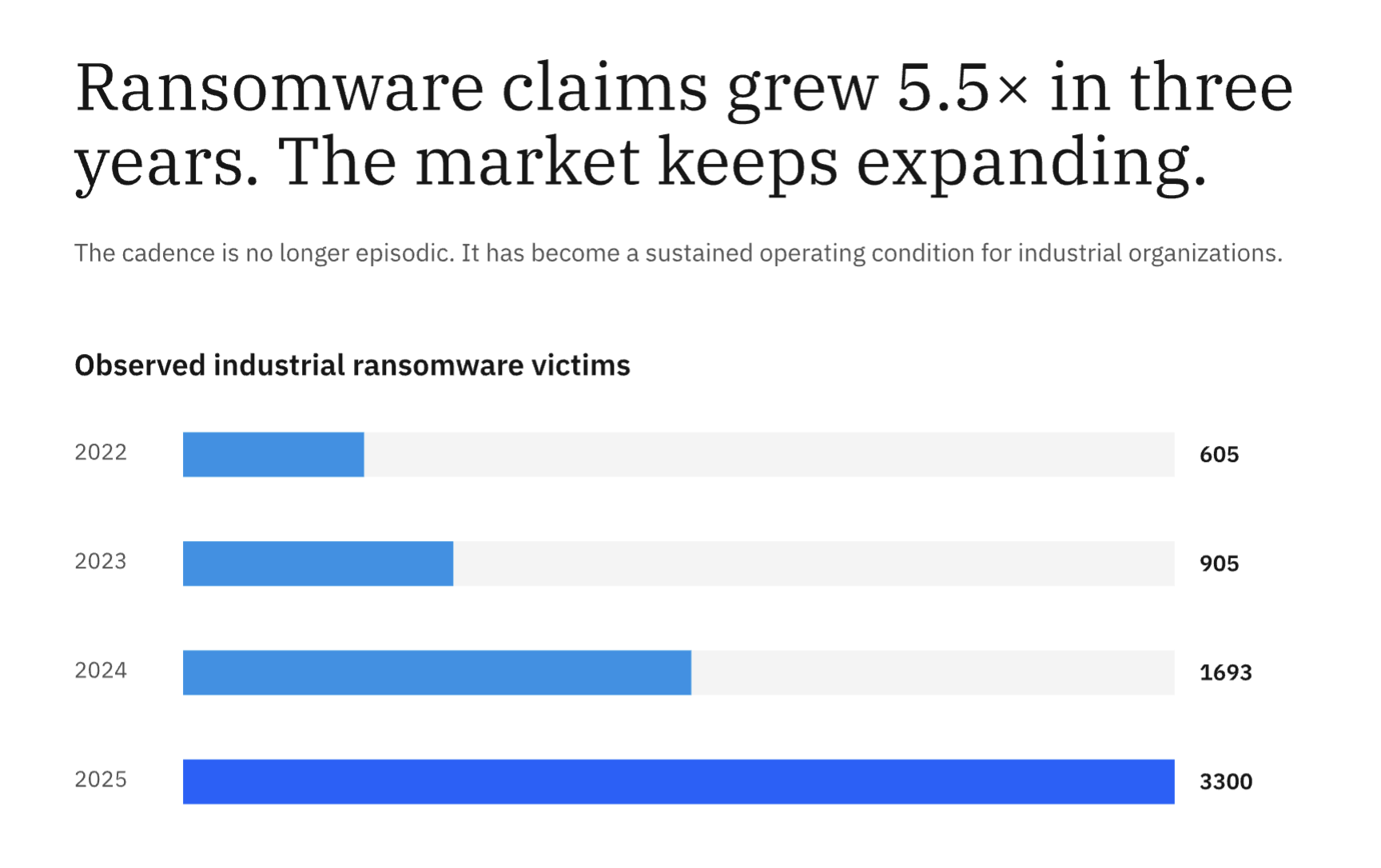
In a single quarter, we have seen 60% of the total volume observed in all of 2024. The number of ransomware groups targeting industrial organizations grew from 50 in 2023 to 119 in 2025. We are facing a resilient "affiliate ecosystem" where law enforcement disruption often just redistributes the threat rather than removing it. For the attacker, the factory floor is simply the most reliable place to find leverage.
3. Why Manufacturing is the Ultimate Pressure Point
Manufacturing remains the primary target for extortion, accounting for a massive 62–63% of all industrial victims. This concentration is driven by the so-called "downtime economics." Attackers aren't just looking for data; they are looking for the point of maximum pain where the cost of an idle line exceeds the cost of a ransom.
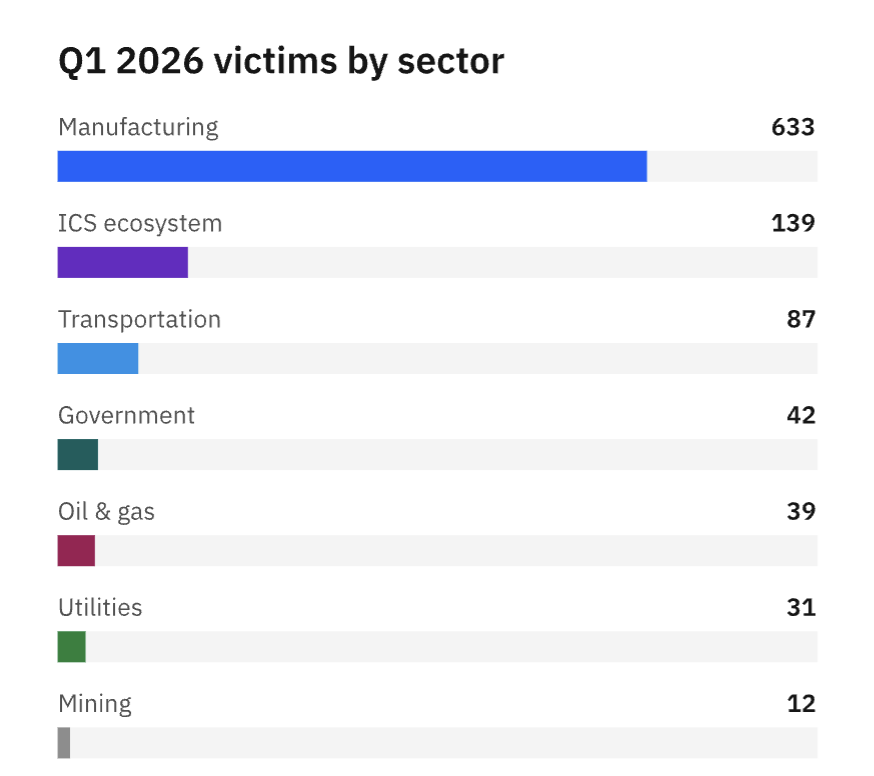
The risk is highly concentrated, with 87.5% of manufacturing claims sitting within the top 10 industrial sectors. Those at the highest risk include:
- Construction-linked manufacturing (152 victims in Q1 2026)
- Equipment production (116 victims)
- Food & Beverage (57 victims)
These sectors combine distributed access, time-sensitive production, and a heavy dependency on shared enterprise platforms. Today, 61% of manufacturing breaches involve ransomware, and in 81% of those cases, the attack is paired with the theft of internal data. Availability pressure and data theft now travel together as a unified weapon.
4. The Industry’s Massive Visibility Blind Spot
You cannot defend what you cannot see, yet the 2026 data reveals that only 30% of OT networks currently have visibility. Even more concerning, 56% of organizations report they cannot see movement once it crosses the IT/OT threshold.
This blindness is the difference between a minor hiccup and a month-long catastrophe. The industry-wide average to detect and contain an OT ransomware incident is a grueling 42 days. However, for organizations that have invested in comprehensive OT visibility, that window shrinks to just 5 days. In the high-stakes world of manufacturing, those 37 days of difference represent the gap between an isolated incident and a total, company-wide halt.
5. The "Boring" Vulnerabilities Winning the War
While the media chases headlines about nation-state cyber-warfare, the data shows that 71% of incidents involve familiar, even boring, hacking methods. We are building digital moats while leaving the front door unlocked.
- Public-facing exploitation (38%): Vulnerabilities in internet-facing systems and web apps.
- Phishing (13%): Standard social engineering that exploits the human element (involved in 56% of breaches).
- Credential abuse (11%): Stolen or weak passwords.
Perhaps the most overlooked risk is the vendor gate. 61% of all breaches now involve third-party exposure. We have created a world where a vulnerability in a vendor's remote access tool is just as lethal as a flaw in our own perimeter.
Conclusion: Beyond the Breach Blast Radius
The modern cyberattack is not any longer limited to the office; the factory floor is now clearly part of it. Owing to the way our infrastructure has been converged, business continuity now completely relies on the condition of IT systems such as identity management and virtualization.
Today's operational resilience relies on protecting the everyday systems that enable production.
What plant managers have to consider nowadays is not the security of their machinery but the efficiency of their plant-safe playbooks. Do you know precisely which of the key production functions depend on your company's network? And more importantly, if those systems were erased tomorrow, would you have at hand a tested, clean-room environment in which to recover them, or would your period of silence amount to 42 days?

Written by
The Parakeet TeamField notes from the people building continuous risk engineering for industrial operations.
.png)