
In this article
- Most Companies Are Flying Blind Beyond Tier One
- What Is Supplier Risk Management?
- Why Supplier Risk Matters for Global Supply Chains?
- What a Strong SRM Program Delivers?
- Key Components of an Effective Supplier Risk Assessment Framework
- Risk Identification: Identify Risks Across Supplier Tiers
- Risk Evaluation: Use Risk Levels And Prioritization
- Risk Mitigation: Actions To Mitigate Risks
- Continuous Monitoring For Operational Resilience
- Six-Step Supplier Risk Management Process
- Best Practices to Reduce Supplier Risk
- Technology and AI in Supplier Risk Management
- KPIs and Metrics to Track Risk Levels
- Industry-Specific Considerations
- Companies Know They're Unprepared—They Just Haven't Fixed It Yet
- Supplier Risk Management: Real-World Lessons
- What Failure Looks Like
- What Success Looks Like
- How Parakeet Risk Helps Reduce Supplier Risk?
- Conclusion And Next Steps
A proactive approach to Supplier Risk Management is a critical facet of maintaining operational excellence and supply chain resilience in industrial sectors, where disruptions can have cascading effects across global manufacturing networks.
In this article, we cover supplier risk management for industrial global supply chains – its importance for industrial GRC buyers, implementation strategies, and how Parakeet Risk serves as an AI-native solution to enhance supply chain visibility and control.
According to McKinsey:
A global advanced-industries manufacturer that restructured its supply network around quantified sourcing risk saw 8–20% higher shipments, 30–50% lower expedited-service costs, and 15–20% improvement in inventory turns.
Industrial companies that invest in advanced supplier risk management capabilities see fewer supply disruptions and achieve greater operational resilience in volatile markets.
Most Companies Are Flying Blind Beyond Tier One
The chart below, from McKinsey's 2025 annual survey of 100 supply chain leaders across industries, illustrates one of the most persistent blind spots in supplier risk management: the overwhelming majority of companies understand their supply chain risks only as far as their direct, tier-one vendors.
What stands out immediately is that the most exposed sectors—automotive, pharmaceuticals, semiconductors, and aerospace—sit in the upper-right quadrant, where both vulnerability and impact are highest. Yet these are precisely the industries where multi-tier supplier dependencies run deepest.
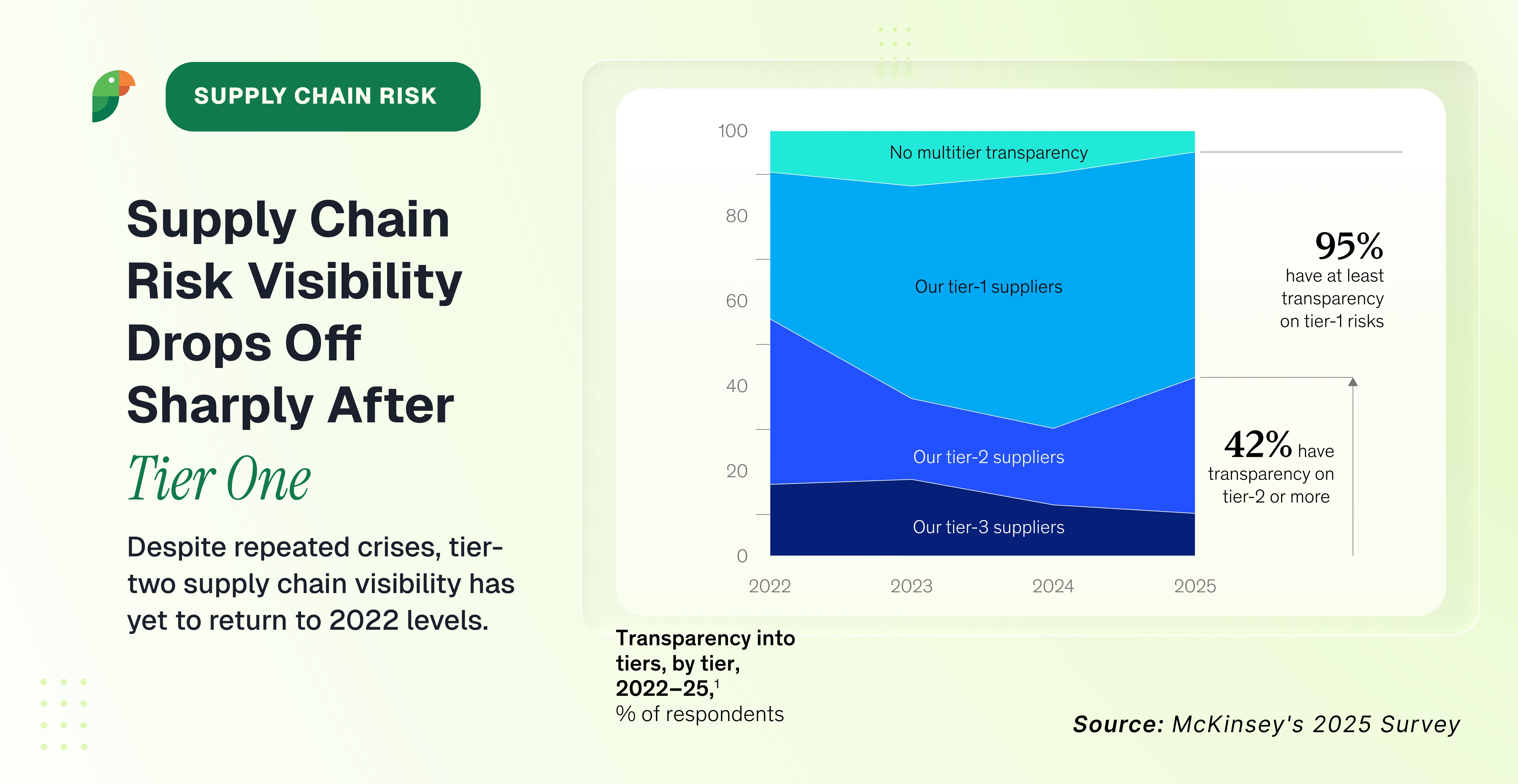
McKinsey's data shows that awareness of risk at tier two and beyond actually declined in 2023 and 2024 as pandemic-era urgency faded—and as of 2025, has still not recovered to 2022 levels. Even with the renewed pressure of tariff volatility, companies have backslid on the very capabilities they built during the crisis years.
The takeaway for industrial operations is direct: a supplier scorecard that stops at tier one leaves the most consequential risks—raw material shortages, sub-tier financial failures, geopolitical exposure—completely unmonitored.
What Is Supplier Risk Management?
Supplier Risk Management (SRM) for industrial operations is the process of identifying, assessing, and mitigating risks across complex, multi-tier supply networks—so a problem with one vendor doesn't shut down an entire production line.
In industrial settings, this goes well beyond tracking on-time delivery or negotiating better pricing. SRM covers the full supplier lifecycle—from onboarding and qualification through continuous monitoring to offboarding—with a focus on operational continuity, quality, safety, and regulatory compliance.
Industrial supply chains face unique complexities due to their global reach, specialized components, and stringent regulatory requirements. Critical suppliers often provide essential components, materials, or services that directly impact production capabilities and safety standards.
A robust supplier risk management strategy is essential for industrial buyers to navigate these challenges effectively. By systematically identifying and assessing supplier risks across all tiers, organizations can enhance operational resilience and maintain compliance with industry regulations.
Why Supplier Risk Matters for Global Supply Chains?
Globalization made industrial supply chains faster and cheaper—but also far more fragile. When your critical components come from factories spread across three continents and a dozen regulatory jurisdictions, a disruption anywhere can cascade everywhere.
We've seen it play out repeatedly:
- COVID-19 (2020–2021) exposed how quickly just-in-time models collapse when borders close and factories shut down. The resulting semiconductor shortage alone wiped out over 10 million vehicles from global auto production in 2021, costing the industry an estimated $210 billion in lost revenue.
- The Suez Canal blockage (2021) showed how a single infrastructure chokepoint—one stuck container ship—can hold up $9.6 billion in trade per day and ripple through supply chains for months.
- Ongoing tariff volatility continues to reshape sourcing strategies in 2026, with 72% of trade professionals identifying U.S. tariff unpredictability as the most impactful supply chain disruptor.
Industrial supply chains are global, heavily regulated, and built on specialized components. A single critical supplier can provide materials or services that directly affect whether you can run production safely and on schedule. That concentration of dependency creates real exposure.
What a Strong SRM Program Delivers?
A well-built SRM strategy helps industrial organizations spot risks early, maintain compliance, and keep operations running when disruptions hit. It strengthens supply chain resilience, promotes accountability across procurement, and reduces the likelihood that a single supplier issue cascades into a company-wide problem.
The 2020 semiconductor shortage is a clear example. Automotive and electronics manufacturers without strong SRM programs faced months of production halts, scrambled sourcing, and ballooning costs—all because they lacked visibility into how dependent they were on a narrow set of chip suppliers.
Industrial manufacturers that lacked robust supplier risk management systems experienced prolonged production halts, supply shortages, and increased costs due to their dependency on concentrated supplier bases for critical components.
Key Components of an Effective Supplier Risk Assessment Framework
A solid SRM framework boils down to four interconnected activities: identify risks, evaluate them, mitigate the serious ones, and monitor everything continuously.
Risk Identification: Identify Risks Across Supplier Tiers
Start by mapping your supplier relationships—not just Tier 1, but deeper into the supply base where critical raw materials and components actually originate. Use a mix of financial health monitoring, on-site audits, geopolitical analysis, and third-party data feeds (credit monitoring, sanctions lists, regulatory databases) to surface risks you wouldn't catch from a self-assessment questionnaire alone.
Risk Evaluation: Use Risk Levels And Prioritization
Not every risk deserves the same attention. Score suppliers based on impact severity, likelihood, and how detectable the risk is within your current systems. Segment them into clear tiers—low, medium, high, critical—so you can allocate monitoring resources proportionally. A single-source supplier for a critical component needs a fundamentally different level of oversight than a commodity vendor with five alternatives.
Risk Mitigation: Actions To Mitigate Risks
For high-risk suppliers, the playbook includes diversifying across geographies and technology platforms, tightening contractual SLAs with clear penalty structures, and verifying insurance coverage regularly. The goal is to reduce both the probability and the blast radius of a disruption.
Continuous Monitoring For Operational Resilience
Annual audits leave months-long blind spots. Modern SRM programs use real-time monitoring—automated certificate tracking, financial health alerts, regulatory change feeds, and logistics telemetry—to catch problems early instead of discovering them during the next scheduled review.
Parakeet Tip:
Set automated alerts for critical risk threshold breaches and wire supplier risk scores directly into procurement decision workflows, so risk isn't an afterthought in sourcing decisions.
Six-Step Supplier Risk Management Process
Navigating supplier risk effectively in industrial environments requires a structured approach with six key steps that ensure comprehensive coverage and consistent execution. Here's a practical framework for building your program:
- Define scope and objectives. Clarify which suppliers, risk categories, and business units are covered. Set measurable goals for risk reduction and resilience.
- Assess each supplier. Evaluate financial stability, operational capabilities, regulatory compliance, geographic exposure, and strategic importance using standardized criteria.
- Classify by criticality and risk level. Segment your supplier base so critical, single-source relationships get enhanced monitoring while lower-risk vendors follow standard processes.
- Build mitigation plans for high-risk suppliers. Document alternative sourcing options, enhanced monitoring protocols, contractual improvements, and contingency procedures.
- Deploy continuous monitoring and alerts. Track performance, compliance, and external risk factors in real time. Automate notifications so teams can act before problems escalate.
- Review and update regularly. Evaluate program effectiveness on a set cadence. Update controls as regulations shift, business needs change, and new risks emerge.
This structured approach enables industrial organizations to proactively manage supplier risks, strengthen supply chain resilience, and maintain operational continuity even during challenging market conditions.
Best Practices to Reduce Supplier Risk
Supplier risk management in industrial environments relies on proven best practices that ensure robust operations and effectively mitigate potential disruptions:
- Standardize due diligence across all supplier categories so no critical risk factors get missed during evaluation.
- Build a risk-aware culture across procurement, operations, and quality teams. Risk management works best when it's embedded in daily decisions, not siloed as a compliance activity.
- Use multiple data sources for supplier decisions—combine external risk intelligence and financial monitoring with internal assessments to avoid blind spots.
- Document escalation and remediation paths with clear ownership, responsibilities, and timelines. When something goes wrong, people shouldn't be guessing who handles it.
Governance and Roles: Build An Effective Supplier Oversight
Assign clear ownership for supplier risk decisions at the right organizational level. Senior leadership owns strategic oversight of critical relationships; operational teams handle day-to-day monitoring. Define escalation thresholds that trigger specific actions based on risk severity—this prevents both under-response to real threats and unnecessary noise from routine issues.
Create multi-tier governance structures that address both strategic risks requiring executive attention and operational risks managed at functional levels. This tiered approach ensures appropriate escalation while enabling efficient management of routine risk activities.
Clear thresholds prevent both under-response to significant risks and unnecessary escalation of routine issues.
Technology and AI in Supplier Risk Management
AI is reshaping how industrial organizations manage supplier risk in 2026. Agentic AI platforms now track financial health, geopolitical disruptions, ESG compliance, and certification status across millions of suppliers in real time—reducing manual oversight by up to 80% in some implementations.
Key technology capabilities to look for:
- Predictive analytics that identify emerging risks before they hit operations
- Automated compliance monitoring that continuously scans regulatory databases and flags updates impacting your vendors
- Integration with procurement systems so risk scores inform sourcing decisions at the point of action, not after the fact
Parakeet Tip:
Deploy AI-powered risk monitoring platforms like Parakeet Risk that integrate multiple data sources and provide predictive analytics for early risk detection, processing supplier data continuously and alerting teams to threats before they impact operations.
KPIs and Metrics to Track Risk Levels
Key performance indicators (KPIs) for industrial supplier risk management are essential for monitoring and managing supplier relationships effectively. Here are critical KPIs to track and their operational impact:
Process KPIs
- Risk assessment coverage: Percentage of suppliers assessed within defined timeframes
- Risk response time: Time from risk identification to mitigation implementation
Performance KPIs
- Supplier risk score: Aggregated ratings across your portfolio, tracked over time
- On-time delivery and quality metrics: Defect rates and delivery performance as leading indicators of deeper issues
Compliance KPIs
- Regulatory compliance rate: Adherence to industry standards, safety requirements, and legal obligations
- Certificate validity: Currency of required certifications and insurance coverage
Risk and ESG KPIs
- Financial health indicators: Credit scores, payment behavior, and financial statement trends
- Geographic risk exposure: Supplier concentration in high-risk regions
- Environmental and social metrics: Sustainability practices, labor standards, and carbon footprint reporting
Parakeet Tip:
Parakeet Risk's supplier monitoring platform provides real-time dashboards aggregating performance, compliance, and risk metrics across your entire portfolio, with AI-powered analytics that surface trends and anomalies for proactive intervention.
Industry-Specific Considerations
Industrial sectors face unique supplier risk challenges that require tailored approaches based on specific operational requirements and regulatory environments.
- Manufacturing suppliers require specialized risk assessment frameworks that address production capacity, quality system certifications, and supply chain dependencies for critical components. Manufacturing risk evaluation must consider supplier financial stability, production flexibility, and ability to scale operations during demand fluctuations.
- Energy sector suppliers face intensive regulatory and safety requirements that demand enhanced oversight of environmental compliance, safety certifications, and emergency response capabilities. Energy sector risk management must address both operational risks and regulatory compliance across multiple jurisdictions with varying safety standards.
- Construction and mining operations require stringent contractor compliance monitoring that addresses safety performance, insurance coverage, and regulatory certifications. These sectors face significant liability exposure from contractor activities, making comprehensive risk assessment and ongoing monitoring essential for operational safety and legal compliance.
Sector | Key Risk Focus Areas |
|---|---|
Manufacturing | Production capacity, quality certifications, supply chain dependencies for critical components, ability to scale during demand swings |
Energy | Environmental compliance, safety certifications, emergency response capabilities, multi-jurisdiction regulatory requirements |
Construction & Mining | Contractor safety performance, insurance coverage verification, regulatory certifications, liability exposure from contractor activities |
Each sector needs to adapt the standard SRM framework to its specific regulatory environment and operational risks while maintaining comprehensive coverage of common factors like financial stability and compliance.
Companies Know They're Unprepared—They Just Haven't Fixed It Yet
The chart below, from McKinsey's 2025 survey of global supply chain leaders, captures a candid self-assessment: when asked to rate the maturity of their company's supply chain capabilities across multiple dimensions, respondents consistently gave their lowest scores to long-range supply visibility—specifically, the ability to anticipate and plan for supply chain conditions over the next five years.
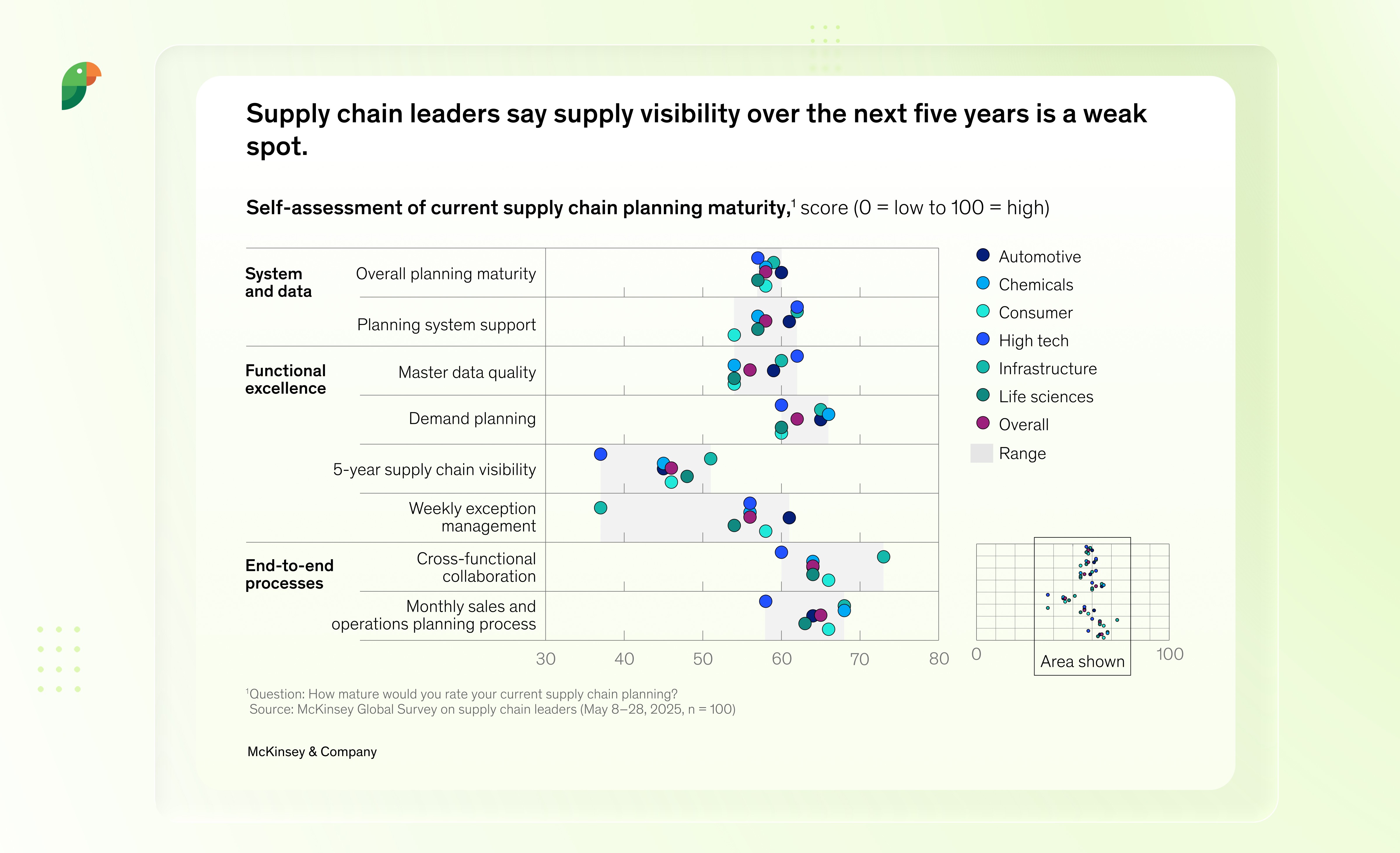
Across nearly every industry, "supply chain planning maturity over the next five years" sits at the far left of the scale—meaning companies themselves rate it as their weakest capability. Higher-maturity capabilities, such as day-to-day inventory management and direct supplier communication, cluster toward the right. The gap between short-term operational competence and long-term strategic visibility is significant and consistent across sectors.
Supplier Risk Management: Real-World Lessons
Key actionable lessons for industrial operators include: diversify critical suppliers across geographic regions, maintain documented business continuity plans, implement early warning systems for supplier financial health, and regularly test contingency plans through scenario planning exercises.
What Failure Looks Like
In May 2018, a fire at the Meridian Magnesium plant in Eaton Rapids, Michigan—a key supplier of instrument panels to Ford, GM, BMW, and Mercedes-Benz—shut down a 208,000-square-foot facility that was the town's largest employer. The plant had accumulated multiple OSHA violations in the years prior. Several major automakers experienced production shutdowns lasting weeks because they lacked backup suppliers for those critical components.
What Success Looks Like
Manufacturers that entered the 2020 supply chain crisis with diversified supplier bases, financial monitoring systems, and pre-built contingency plans were able to activate alternative sourcing quickly and maintain production schedules while competitors scrambled. The lesson is consistent: proactive planning, comprehensive monitoring, and tested contingency plans make the difference between a manageable disruption and an operational crisis.
These examples demonstrate that effective supplier risk management requires proactive planning, comprehensive monitoring, and rapid response capabilities to maintain operational resilience during unexpected disruptions.
How Parakeet Risk Helps Reduce Supplier Risk?
Parakeet Risk's AI-native platform is built specifically for industrial supplier risk management:
- Rosella AI automates compliance workflows—continuously monitoring supplier certifications, insurance coverage, regulatory status, and financial health, reducing manual oversight while ensuring consistent application of risk criteria.
- Continuous monitoring provides real-time visibility into supplier performance through integrated telemetry and regulatory-change feeds. Automated alerts enable immediate response when suppliers face financial difficulties, regulatory violations, or operational disruptions.
- Certificate and COI verification tracks expiration dates, monitors renewal status, and sends automated notifications to prevent compliance lapses.
- Regulatory-change integration monitors evolving requirements across jurisdictions and alerts both buyers and suppliers to required compliance actions.
Ready to see it in action? Book a demo to explore how Parakeet Risk can strengthen your industrial supply chain resilience.
Conclusion And Next Steps
If you're starting from scratch, begin with a focused pilot covering your most critical suppliers—the ones where a disruption would directly impact production or safety. Build the assessment framework, deploy monitoring, measure results, then expand across the full portfolio. For organizations ready to accelerate, AI-native platforms like Parakeet Risk can compress that timeline significantly while reducing the manual burden on procurement and compliance teams.
Sources:
- Hempel, L., Conway, M., Doheny, M., & Singhal, S. (2026, January 8). Decoding disruption to reshape manufacturing footprints. McKinsey & Company.

Written by
Jowanza JosephCEO, Parakeet Risk