Gestión de Riesgos
19 mar 2026
8 Contractor Prequalification Mistakes (and Best Practices to Avoid Them)

Jowanza Joseph
CEO, Parakeet Risk

The contractors and subcontractors you approve today determine the risk your organisation carries tomorrow. Here are the eight prequalification mistakes that create that risk — and how to close them.
The prequalification process sets the standard for every supplier that enters your contractor network. When documentation gaps go unchecked, financial red flags get overlooked, and approved lists go months without a review, non-compliant contractor move quietly through your third-party network — and the consequences land on projects and the organisation.
What Is the Prequalification Process?
Prequalification is your first real line of defense. It's where project owners and general contractors decide who earns a spot at the table — before the bids are even submitted.
Prequalification evaluates contractors or subcontractors before inviting them to tender. It covers financial health, safety records, workforce competency, insurance, licences, and track record on previous projects. For general contractors and procurement teams, it’s a critical risk reduction tool—filtering out contractors and subcontractors who pose unacceptable risks before they ever enter the bidding process.
Compliance managers rely on prequalification to mitigate risks and ensure they hire only reliable contractors. For the latter ones, passing prequalification is equally important, as it opens doors to bigger projects and gives high-value opportunities.
📗 For more tips, read our ultimate guide to contractor prequalification
General contractors, developers, and project owners invest significant time and effort in prequalification — and for good reason. Done well, it's a toolkit for avoiding contractor default, poor workmanship, and the future project disruptions.
The Hidden Cost of Getting Contractor Prequalification Wrong
Viewing prequalification as mere paperwork creates gaps: non-compliant suppliers enter your network, approved lists go stale, and problems emerge mid-project.
What is the organisational cost? Weak vetting damages credibility with clients, insurers, and procurement stakeholders who rely on your due diligence. When non-compliance surfaces—whether it’s a safety issue, financial failure, or regulatory breach—it raises the same questions:
What did your prequalification process truly verify?
Where were the gaps in oversight?
Contractor prequalification mistakes expose your organisation to significant risks — from safety incidents to legal issues and project delays. But these errors are rarely accidental. Most often, they result from treating compliance as a checkpoint rather than a continuous discipline.
Organisations that maintain accurate records, conduct regular audits, and hold subcontractors to consistent compliance standards build the kind of operational credibility that holds up when things go wrong. A strong safety culture doesn't happen by accident — it requires staying proactive with up-to-date compliance documents and applying the same standards at every stage of the prequalification phase.
According to surety industry data cited by the International Risk Management Institute,
up to 35% of project defaults are linked to risks that were flagged during prequalification but ultimately ignored.
The errors that derail prequalification are often preventable — and surprisingly consistent.
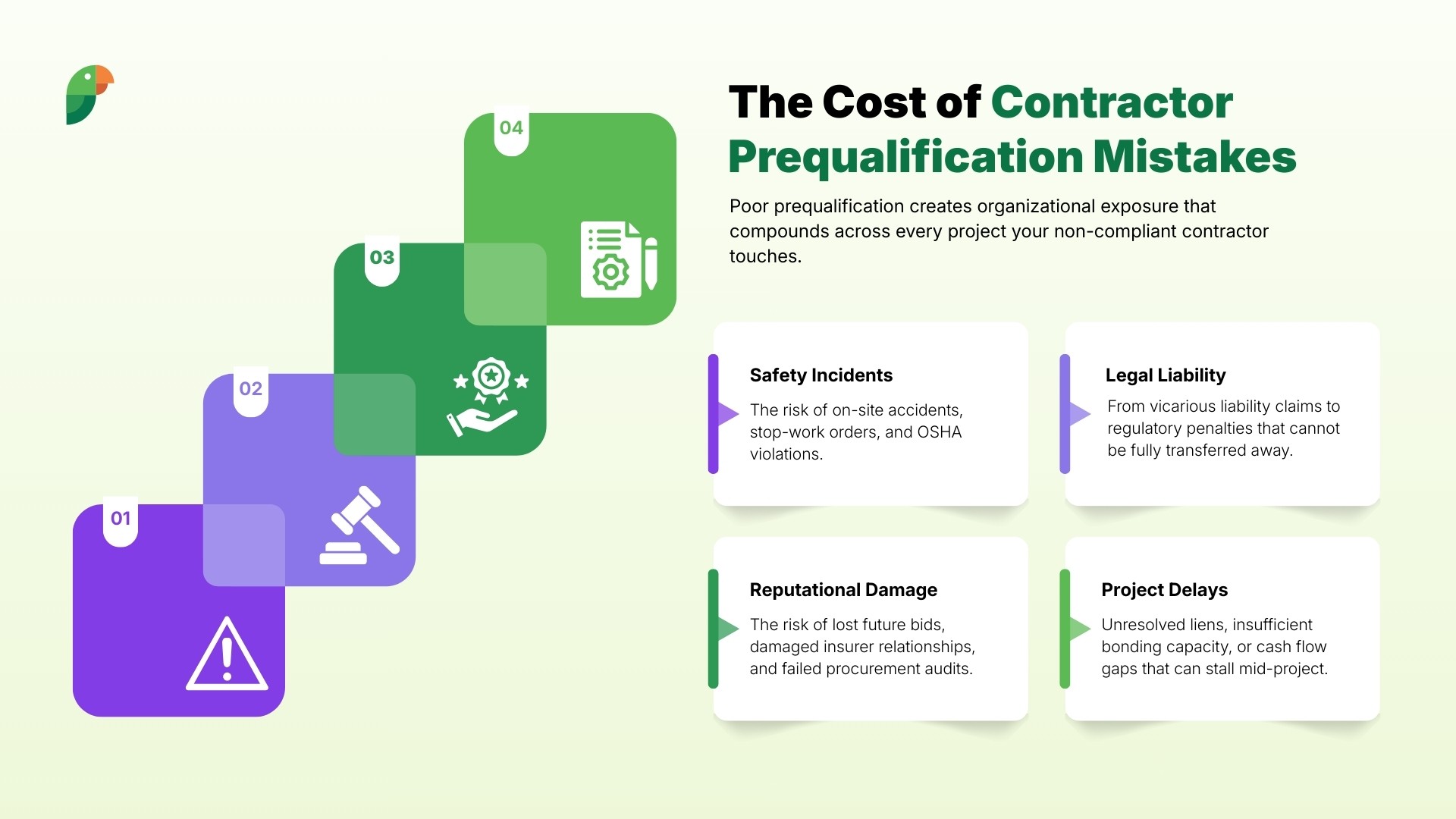
🟢 Here's a breakdown of the most common prequalification mistakes contractors and subcontractors make, and what you can do to stay ahead of them.
8 Common Mistakes in Contractor Prequalification Process + Tips How to Avoid Them
Understanding where prequalification breaks down protects your organisation from non-compliance, financial instability, and upholds the industry standards your clients and regulators expect.
1. Submitting Incomplete or Disorganized Documentation
This is the most frequent — and most avoidable — mistake on the list. Contractors are typically required to submit financial statements, insurance certificates, licensing records, safety plans, and training logs. Rushing through the checklist, missing attachments, or submitting outdated versions makes your company appear disorganized and unable to handle compliance obligations. The stakes are high; inconsistent project histories or missing reference details raise red flags, and that may trigger deeper audits.
Accepting incomplete document packages creates immediate liability for your procurement process. That’s why the prequalification process should require — and enforce — complete safety and compliance documentation at submission.
🟩 How to fix it? Build a documentation library that's always audit-ready. Assign someone to own and control the process.
💡 Risk Tip:
Your prequalification system should automatically reject incomplete submissions, rather than relying on reviewers to chase missing documents.
2. Overreliance on Manual Processes
Manual renewals and reminders scale poorly as contractor pools grow, raising administrative overhead and creating gaps in third-party oversight. Relying solely on manual processes to manage contractor submissions increases the likelihood of human error. Spreadsheets and email workflows lack real-time visibility, causing missed expiries and non-compliance incidents, especially when organisations try to stretch traditional spreadsheet-based compliance workflows beyond their practical limits.
💡 Risk Tip:
Platforms like Parakeet can help streamline the documentation process and ensure critical information is easily accessible. This reduces the risk of a lapsed certificate going unnoticed.
3. Weak Financial Stability Evidence
A contractor's financial health is one of the clearest predictors of project delivery risk. Insufficient evidence, like absent or unaudited financials, makes verifying cash flow, bonding capacity, or solvency impossible.
💡 Risk Tip:
Requiring accountant-reviewed financials as a non-negotiable standard gives decision-makers the confidence to approve.
High debt ratios, late payments, or outstanding liens should be automatic red flags in your review process. Failing to scrutinise a contractor's financial records at the prequalification stage risks onboarding a contractor that becomes insolvent mid-project — disrupting operations, fragmenting your supply chain, and creating timeline and cost exposure that your organisation must manage.
Your prequalification criteria should include defined financial thresholds that objectively filter high-risk contractors before they reach your approved list, strengthening upstream controls that also underpin risk transfer tools such as Subcontractor Default Insurance for construction risk leaders.
4. Poor Safety Records and Recordkeeping
Contractors who cannot demonstrate up-to-date safety compliance programs and protocols present a measurable risk to your projects. Missing OSHA logs, training records, or EMR (Experience Modification Rate) history should never reach your approval stage.
💡 Risk Tip:
Your prequalification system should treat incomplete safety documentation as an automatic disqualifier.
Lapses in certifications, absent safety plans, and unresolved incident records are not only administrative oversights. These are the signals of a weak safety culture that raise the likelihood of accidents, stop-work orders, and liability exposure on your sites. Neglecting safety performance metrics at the prequalification stage means these risks enter your contractor network undetected.
Safety statistics matter beyond optics. Fragmented safety records hinder benchmarking against industry standards. Without consistent, structured safety data across your contractor pool, you cannot identify underperformers early. What's more, it is harder to demonstrate continuous improvement to auditors or insurers.
Your prequalification criteria should always require standardised safety submissions. In this way, safety performance is comparable, trackable, and defensible, and it becomes far easier to embed them into a broader industrial third-party risk assessment process that covers your full contractor and supplier network.
5. Non-Compliance with Industry Standards
Beyond credentials, prequalification criteria need to account for active regulatory changes across relevant jurisdictions. Ignoring those updates creates legal exposure and post-award remediation costs that your organisation absorbs, not the contractor.
📗 Find out how to build a robust compliance and risk management framework.
Your prequalification process should map each contractor's credentials against the jurisdictional, environmental, and trade-specific standards that apply to the actual project at hand — not just a generic compliance checklist. Contractors who cannot demonstrate current, scope-relevant compliance represent the downstream risk that your prequalification process exists to prevent.
6. Insufficient Contractor Management and Ongoing Oversight
Prequalification is the starting point of your governance responsibility — not the end of it. A contractor who cleared your process two years ago may have since let certifications lapse, replaced key personnel, or accumulated safety incidents that introduce entirely new risk into your network. Without continuous monitoring, that degradation goes undetected until it becomes a project problem.
Without defined performance KPIs and a centralised contractor management system, there is no early warning signal for underperformance — and no single source of truth when audits are needed.
Your approved list should reflect live compliance status, not a historical snapshot. Automated supplier due diligence platforms make real-time oversight of multi-tier contractor networks operationally viable.
📗 Explore the benefits of integrating cloud-based construction management platforms like Procore and Parakeet
7. Unverified Experience and Performance History
Experience mismatch is a high-impact prequalification mistake. Inflated project scope or unverified references distort risk profiles and misalign expectations. Hiring a contractor experienced in general construction but lacking specific expertise for specialized projects leads to poor-quality work and project delays.
This is where manual review processes fail most quietly. Checking references, cross-validating project histories, and confirming workforce competency across a large contractor pool is time-intensive work — and under time pressure, it gets compressed or skipped.
Automated prequalification platforms like Parakeet Risk help close this gap by flagging unverifiable submissions, checking declared experience against trusted data, and preventing contractors from moving forward with unverified claims.
8. No Requalification Cadence and Stale Approved Lists
An approved contractor list is only as reliable as its last update. Without defined requalification schedules, expired certifications and lapsed documents persist unnoticed. As a result, your compliance team may continue assigning work to contractors who no longer fit the role.
A robust prequalification procedure includes a defined requalification schedule, automated expiry alerts, and a clear remediation pathway for contractors who no longer meet compliance requirements.
Consequences of Contractor Prequalification Mistakes
Gaps in prequalification carry costs beyond individual projects:
Mistake Consequence | Organisational Impact |
|---|---|
Onboarding non-compliant contractors | Limits access to high-value, public-sector, and regulated-industry contracts where vetting standards are audited |
Repeated compliance failures | Damages your organisation's reputation with clients, insurers, and regulators — reducing future contract and partnership opportunities |
Insufficient financial vetting | Increases financial exposure through penalties, remedial works, or disputes that trace directly back to inadequate supplier screening |
No ongoing performance monitoring | Project delays from rework, safety incidents, or contractor turnover generate cost overruns your organisation absorbs |
Accepting expired or unverified documents | Creates direct legal liability — no contractual clause fully transfers that risk away from the party that approved the submission |
Best Practices to Avoid Mistakes While Prequalifying Contractors
Automate the Prequalification Process
Automated certificate checks catch expired documents early and speed onboarding. Use a central portal and set automatic alerts for expiring licences or insurance to reduce delays and risk.
Strengthen Financial Stability Assessments
Require audited financial statements and cash flow forecasts for at least two prior years. Run credit checks, lien searches, and verify bonding capacity. Apply consistent scoring thresholds to filter high-risk contractors.
Raise Safety Standards and Recordkeeping
Require OSHA logs, EMR history, and current training records. Incorporate safety KPIs and audit results to benchmark contractors. Mandate incident investigations and corrective actions to verify safety maturity.
Standardize Required Documentation
Use templates and metadata tags to ensure consistent submissions and make audits easier. Enforce single-format certificate uploads for automated validation. Designate a team member to manage a central document repository to keep everyone on the same page.
Embed Ongoing Contractor Management
Implement periodic requalification and real-time monitoring of certificates, safety events, and KPIs. You can link contractor management to your procurement systems to provide real-time compliance status.
Leveraging integrated construction and risk platforms will help you adhere to industry standards and legal requirements across complex projects. Choose digital tools that are designed to solve industrial problems. In this way, you can adjust contractor prequalification to the specific regulations.
Prequalification Procedure Checklist
Verify up-to-date insurance certificates with issuer validation and correct coverage.
Require audited financials, bank references, and cash flow projections.
Collect OSHA 300 logs, training matrices, and EMR data for the last five payroll years.
Confirm licences and trade certifications against issuing authority registries.
Run credit searches, lien histories, and payment profiles for financial red flags.
Define requalification cadence and automated expiry alerts.
Establish measurable KPIs and transparent remediation pathways.
How Technology Can Help You Reduce the Risk of Contractors' Non-Compliance at the Prequalification Stage?
Automated contractor management platforms with weighted scoring help you avoid the common pitfalls that manual processes miss. AI-assisted workflows speed up document validation and flag anomalies.
📗 Read about new obligations around compliance in the age of AI that your governance and risk teams must address.
Modern third-party risk management platforms automate due diligence, certificate verification, and regulatory monitoring. It reduces the need for manual reviews, saves time, and minimizes errors. As a result, project managers gain real-time visibility into contractor compliance.
🦜 Contact our team to learn how Parakeet Risk automates certificate verification, regulatory monitoring, and due diligence, keeping your prequalification process accurate, auditable, and up to date.