Tendencias de Riesgo
7 abr 2026
Strategic Supply Chain Lessons from NASA’s Artemis II Mission

Magdalena Rucińska
Content Specialist
Sending astronauts back to the lunar surface after a hiatus of more than 50 years marks an undeniable triumph of space engineering and a crucial moment in human history. Yet, this project is among the most complex undertakings to manage. What are the critical, behind-the-scenes factors that underpin the success of returning humans to the moon?
This article delves into the project management and logistics framework of the Artemis II mission, specifically extracting vital supply chain lessons. The strategies NASA employs—from risk mitigation in niche manufacturing to managing a sprawling international supplier network—offer direct, transferable insights for managing complex supply chains across any major industry, ensuring reliability and operational excellence in high-value, long-term projects.
Is Logistics behind NASA’s Artemis II Mission Rocket Science? 🌕
While the world focuses on the launchpad and the rocket's trajectory, many do not realize that the key to mission success lies beneath the surface. The invisible architecture is a global supply chain network operating in perfect harmony.

Image Credit: NASA
The Artemis program is not only a marvel of space exploration, but the most rigorous operational testing ground for 21st-century logistics ever assembled.
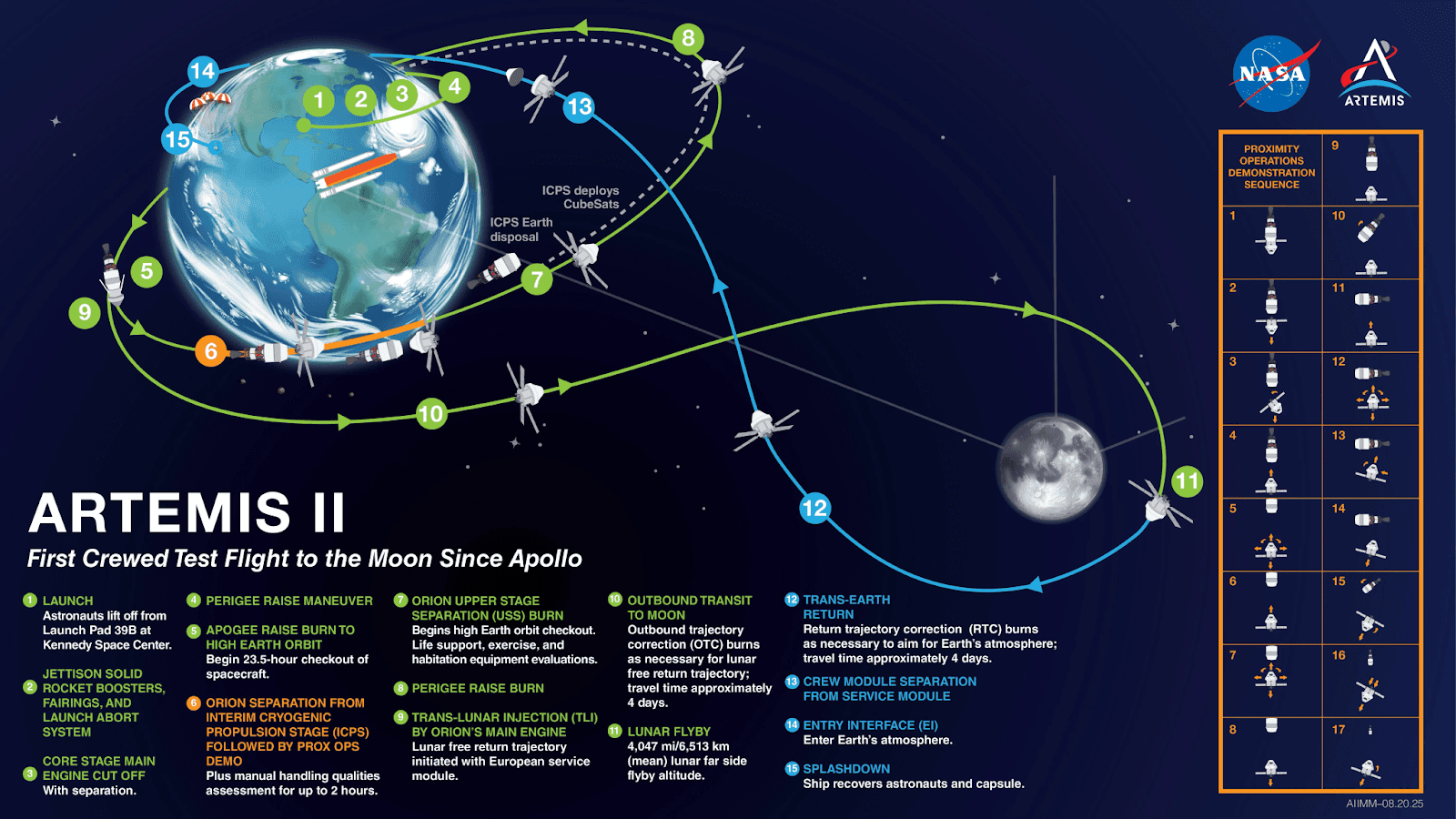
Major Mission Milestones. Source: https://www.nasa.gov/artemis-ii-press-kit
Consider the journey of a single heat shield bolt—serial-numbered, tested to aerospace standards, and tracked via a digital chain of custody—traveling from a machine shop in Ohio to Launch Complex 39B at NASA’s Kennedy Space Center months before that historic moment.
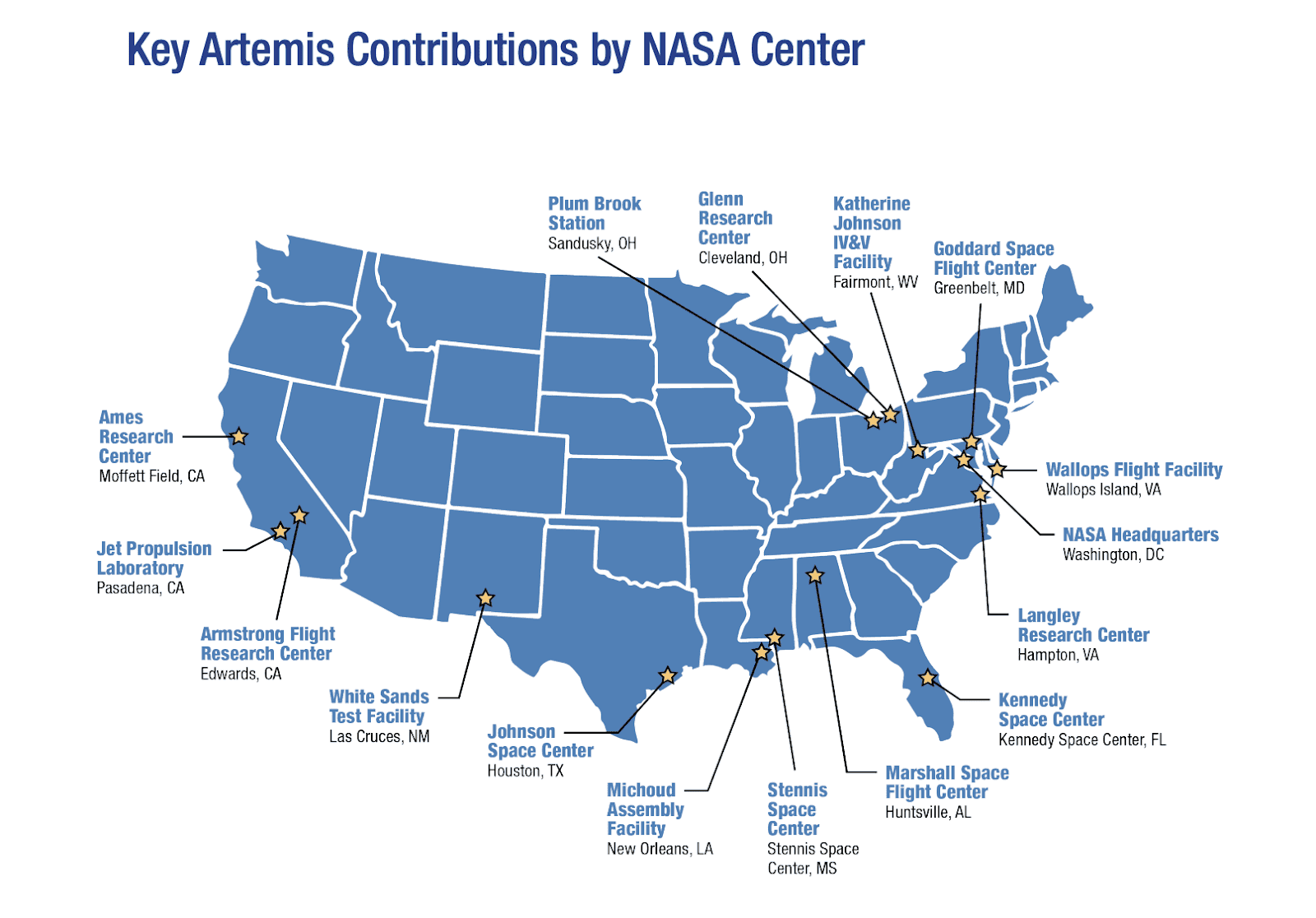
Source: https://www.nasa.gov/wp-content/uploads/2020/12/artemis_plan-20200921.pdf
The logistical map is so complex that a failure even at the tier-four level could halt the entire program. This is more than a space story. The same operational model that ensures a single flawless component reaches the launch pad offers valuable lessons for any industrial leader grappling with complex global supply chains, here on Earth.
Let's explore how NASA’s lunar program provides a masterclass in orchestrating and managing third-party risk at scale. 🚀
Four Astronauts and 2,700 Suppliers: Powerful Teamwork that Drives the Artemis II Mission 👨🚀
On April 1, 2026, four astronauts launched aboard the Orion spacecraft atop the Space Launch System, marking humanity’s first crewed mission beyond low Earth orbit in over five decades. The Orion spacecraft, named Integrity, is currently on its four-day return journey after completing its historic lunar flyby on April 6.
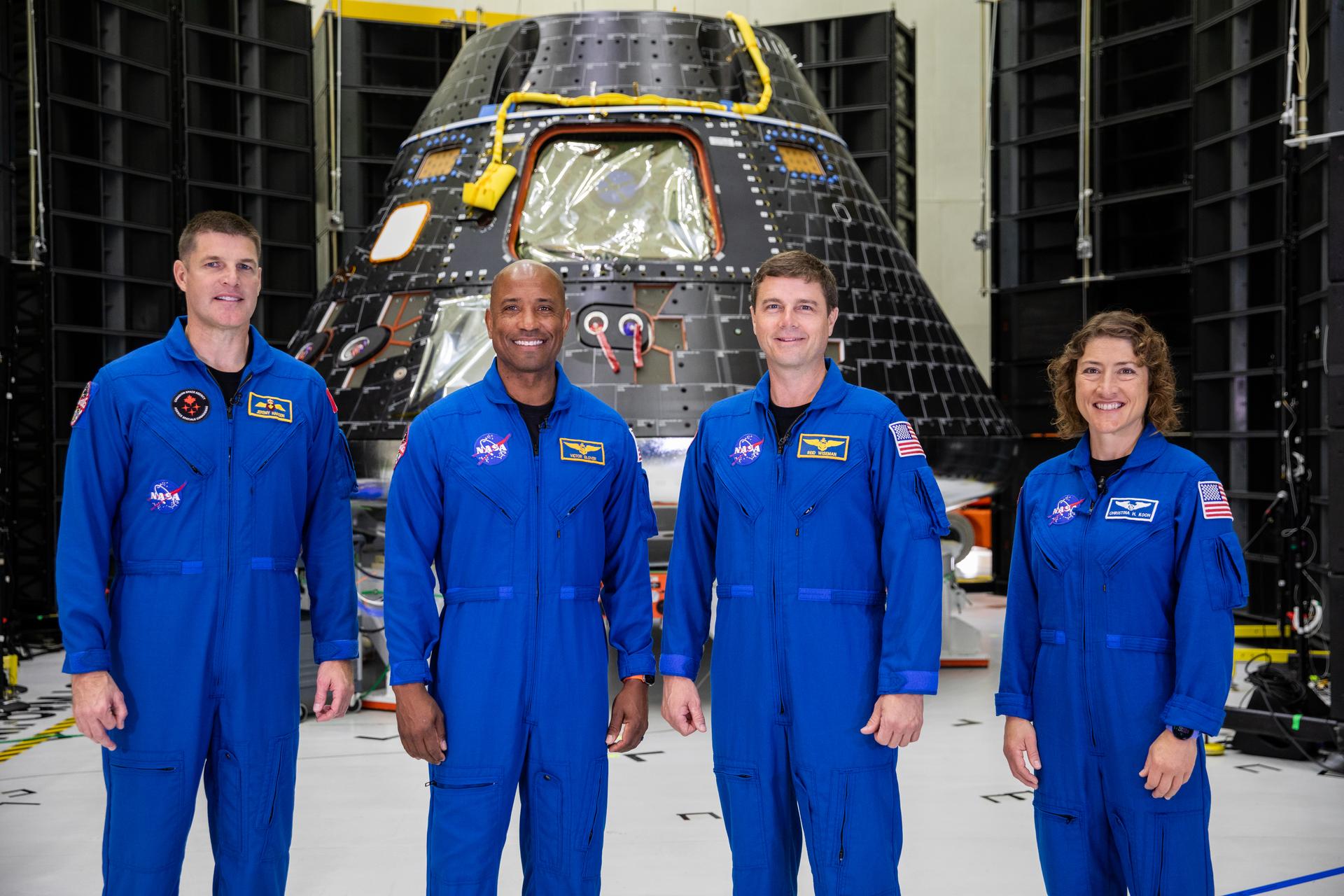
Artemis II crew members at NASA’s Kennedy Space Center in Florida stand proudly before their Orion crew module. From left to right: Jeremy Hansen, mission specialist; Victor Glover, pilot; Reid Wiseman, commander; and Christina Hammock Koch, mission specialist. Credit: NASA/Kim Shiflett
The Artemis II mission, while focused on the four astronauts' journey into space, is fundamentally a product of collective expertise spanning engineering, safety protocols, manufacturing, and logistics.
Artemis II is not a NASA-only project. It is, in fact, an alliance of numerous contractors working at a scale rarely seen in any industry. This collaborative effort—characterized by a unified objective, high-stakes trust, and rigorous execution—is paramount. Though most contractors operate outside the public eye, their disciplined execution and fulfillment of the shared technical requirements remain critical to the mission's viability.
NASA’s Artemis II mission relies on a complex global network of suppliers, including major companies such as Boeing and Airbus.
*Here you can check the full Artemis partners list.
Purpose-driven teams enable the achievement of the most complex objectives, such as the lunar mission.
The invisible architecture of the lunar mission is a supply chain network of more than 2,700 suppliers across the U.S. and Europe.
The figure of 2,700 refers specifically to suppliers directly involved in providing hardware and systems for the Artemis II flight. The overall support network is even larger. According to the Artemis II press kit, approximately 3,800 suppliers from 49 states have contributed to the broader Artemis campaign.
Who are the Key Players in the Artemis II Mission?
The successful journey to the Moon requires a sophisticated network of engineering and manufacturing expertise. NASA's Artemis II mission is powered by a diverse coalition of aerospace industry giants and specialized contractors, each playing a critical role in the complex supply chain that delivers the Orion spacecraft and the powerful Space Launch System (SLS) to the launch pad.
Among the Primary Contractors and Suppliers of Artemis II are:
Amentum: Supports Exploration Ground Systems at Kennedy Space Center (KSC).
Lockheed Martin: Lead contractor for the Orion spacecraft.
L3Harris: Provides the RS-25 engines.
Boeing: Responsible for the core stage of the Space Launch System (SLS).
Northrop Grumman: Provides the boosters for the Space Launch System (SLS).
Airbus (main contractor for ESA): Builds the Orion's European Service Module.
The European Space Agency (ESA) provides Orion’s European Service Module, constructed by Airbus as the lead contractor. Components come from teams in ten European nations—Germany, Italy, Switzerland, France, Belgium, Sweden, Denmark, Norway, Spain, and the Netherlands—as well as the United States. The Artemis II module was assembled at Airbus’s Bremen, Germany, facility before its delivery to NASA.
Next, let's dive into the insights regarding multi-tier procurement and high-efficiency logistics, using the Artemis II mission as a case study.
Main Supply Chain Risks and Lessons from Lunar Space Mission
The Artemis mission demonstrates that the modern supply chain is only as resilient as its most distant supplier. Every part of such a massive industrial ecosystem—from specialized sensors to standard fasteners—must be carefully verified, documented, and traceable. Any missing element, delayed transfer, or unforeseen issue could put the entire mission at risk. At this scale, the traditional procurement model is not enough.
The way NASA navigates this level of high-stakes collaboration provides invaluable lessons for leaders managing complex global supply chains.
1. The "visibility gap" in multi-tier supply chains
A key NASA lesson learned over the past decades involves the significant risk posed by the "visibility gap" within multi-tier supply chains. Traditionally, prime contractors maintained exclusive control over their sub-vendors. This structure left NASA with minimal insight into the operational health of smaller, more distant suppliers—those three or four steps removed from the primary contractor. The consequence of this lack of visibility was severe: the failure of a specialized component manufacturer, such as a valve shop in a remote location, could halt the entire mission.
To mitigate this, NASA shifted its strategy with Artemis 2 contractors, like Boeing and Lockheed Martin. By moving toward more integrated oversight and fixed-price contracts, the agency increased transparency. Logistics managers are no longer just tracking deliveries; they are embedded in the contract lifecycle to monitor the financial and operational health of the entire ecosystem. The lesson for industry is clear: you cannot manage what you cannot see. De-risking requires knowing your suppliers’ suppliers.
In the realm of deep-space exploration, the margin for error is nonexistent. This stringent requirement was underscored by the Defense Logistics Agency (DLA) Energy, which maintained an "unbroken chain of custody" over all mission-critical propellants.
The key strategic lesson for supply chain management lies in the granular nature of quality control:
The Challenge: Minute impurities, even at a microscopic level, in vital materials like liquid hydrogen or toxic fuels, pose a direct threat of catastrophic engine failure.
The Solution: Artemis mission suppliers employed advanced verification protocols, such as gas chromatography, to successfully detect impurities at the parts-per-million level throughout the entire transportation lifecycle.
For commercial enterprises, this experience teaches a critical lesson: as a supply network expands, so too must the granularity of its verification protocols. Quality control should be viewed not merely as a department function, but as a foundational defense against systemic failure.
3. Heritage vs. Innovation: A dual-track procurement strategy
A primary challenge in the Artemis supply chain is balancing the need for cutting-edge innovation with the requirement for absolute reliability. NASA’s solution was a "heritage" strategy that combines reusing proven hardware, such as refurbished Space Shuttle engines, alongside "New Space" technology like 3D-printed components.
This hybrid approach mitigates two specific risks:
Technical Uncertainty: Using "heritage" parts reduces the variables that can go wrong during a launch.
Stabilizing Procurement: By utilizing existing designs, NASA ensures the stability of its niche industrial supplier base, guaranteeing their viability throughout the mission's decade-long lifecycle.
Meanwhile, the adoption of additive manufacturing has allowed the chain to become more agile. By 3D-printing over 150 parts, NASA bypassed traditional, long-lead-time casting processes, effectively shortening the "procurement-to-payload" window.
4. International Synchronization: The multi-tier coalition
The European Service Module (ESM), built by Airbus, involves over 20,000 parts and 12 kilometers of cabling that must integrate flawlessly with American systems. The risk of "siloed" operations—where different regions use different standards—is a common pitfall in global business.
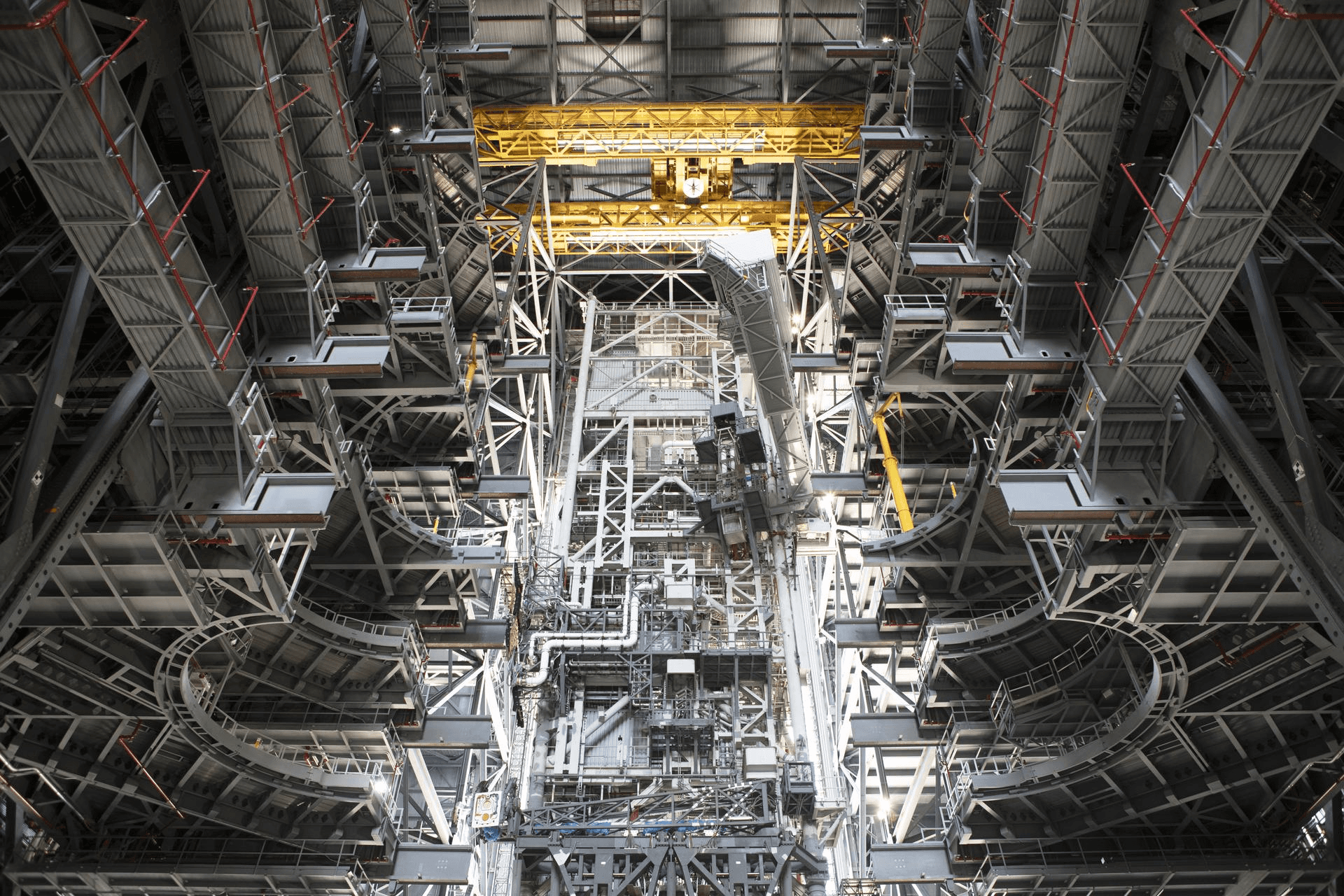
NASA's mobile launcher within High Bay 3 of the Vehicle Assembly Building (VAB) at Kennedy Space Center in Florida. Image Credit: NASA/Frank Michaux
The Artemis supply chain lessons here center on "connected network" models. By standardizing handoffs and technical requirements across continents from day one, NASA and Airbus neutralized the risk of integration errors. This level of international coordination proves that scale and speed are not mutually exclusive, provided that accountability is built directly into the procurement framework.
Direct Takeaways for Industrial Leaders
If 2,700 partners can coordinate to send a crew around the moon, the same principles can be applied to Earth-bound logistics.
What are the fundamental lessons derived from the Artemis supply chain that the C-suite could implement to establish a resilient operation?
Move Beyond Tier One: Invest in the digital infrastructure—the "Digital Thread"—that links design, manufacturing, and testing into a single, real-time record.
Adopt Tech-Enabled Agility: Use tools like Augmented Reality (AR) to reduce labor bottlenecks. In the Artemis assembly, AR slashed task times from eight hours to 45 minutes.
Prioritize Resilience Over Initial Cost: Treat the supply chain as a dynamic capability. Much like the propellants in a rocket, your logistical flow must be handled with a level of precision that assumes disruption is always a possibility.
Treat Strategic Collaboration as Rocket Fuel: Just as NASA relies on a network of private contractors and international partners, view your supply chain not as a cost center, but as a critical ecosystem of strategic partners. Successful operations require deeply integrated collaboration, shared risk, and transparent communication to overcome complex hurdles.
Risk Management Through Modular Design: Artemis II's success hinges on rigorous testing and a system built from reliable, interlocking components. Apply this principle to your model: identify critical failure points and build redundancies or 'modular' solutions into your operations, ensuring a single component failure doesn't jeopardize the entire mission (project/delivery).
The Long-Term ROI of Rigorous Standards: NASA's multi-decade investment in safety and performance standards underpins every mission. This translates to prioritizing quality, compliance, and ethical sourcing, even when short-term costs are higher.
Data-Driven Decision Making is Essential: Every trajectory adjustment and system check on Artemis II is based on real-time data. Similarly, leverage predictive analytics and real-time data monitoring across your supply chain and third-party partnerships. This allows for proactive intervention, optimized resource allocation, and the assurance that mission-critical timelines are met.
Invest in Cross-Functional "Mission Control" Teams: The successful execution of a complex project—like a global product launch or a major infrastructure rollout—requires the same level of centralized, synchronized command as a space mission. Establish cross-functional teams with clear roles, shared visibility, and empowerment to make rapid, informed adjustments.
The companies that will dominate the next decade are those that stop viewing their supply chain as a series of transactions and start seeing it as a collaborative, high-fidelity ecosystem.
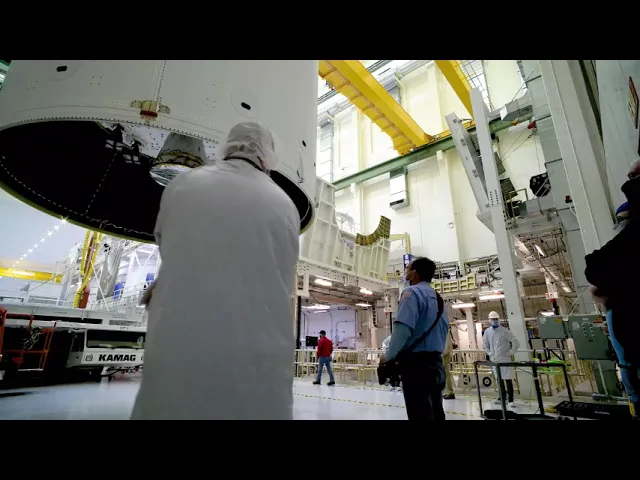
The Artemis I Orion spacecraft is lifted from the FAST cell ahead of its move to the multi-payload processing facility for fueling. Credit: NASA
🛸 Here you can follow the mission updates: Artemis II Launch Day Updates
The conclusion?
Treat your next major capital project as your own Artemis mission!
Want to gain complete visibility and control over your supply chain's third-party risk? Find out more by consulting our CEO's Digital Twin!