Reglamentos
6 jul 2026
Successor Liability in California: Key Insights on Cal/OSHA Citations for Industrial Buyers
As corporate restructuring, mergers, and acquisitions continue to reshape the industrial landscape across the United States, multi-state risk managers are facing a complex legal question: Can Cal/OSHA hold a new company responsible for a predecessor's safety violations? The answer lies in the doctrine of successor liability, which can become a critical blind spot in today’s M&A environment.
This article focuses specifically on successor liability arising from Cal/OSHA citations, tax liabilities, and business acquisitions in California. Understanding successor liability is critical for these groups to effectively manage regulatory risks, negotiate purchase agreements, and ensure compliance, thereby avoiding costly penalties and operational disruptions.
Highlights:
The "Clean Slate" is Dead: Asset purchase agreements no longer automatically protect buyers from a seller's past regulatory issues.
Substantial Continuity: Liability transfers if the new company essentially continues the predecessor's operations using the same facility, equipment, and workforce without interruption.
Cal/OSHA Bears the Burden: The agency must prove they cited the correct legal entity; if they can’t, the citation may be dismissed entirely.
Massive Financial Risk: Taking on a predecessor's safety history means exposure to penalties going back five years, with fines reaching up to $165,514 for repeat violations.
🏛️ What is Successor Liability, and what does it mean for Workplace Safety?
Successor liability in workplace safety means that when one company takes over another, it can be held responsible for the previous owner's safety violations, records, and citation history. This rule, enforced by the Occupational Safety and Health Administration (OSHA), stops companies from simply wiping their safety records clean by restructuring, merging, or buying assets.
Successor liability impacts both the purchase price and the choice between asset and stock purchases. For a long time, industrial risk managers and private equity buyers saw asset purchase agreements (APAs) as a protective shield—allowing them to acquire machinery and trained workers without taking on the seller's regulatory issues.
In the new regulatory reality, the era of the "clean slate" asset purchase is over.
But in today's regulatory environment, the idea of a "clean slate" asset purchase is no longer a guarantee. Anyone involved in buying or selling businesses should understand that acquiring a company with a history of health and safety violations may lead to increased penalties for the new owner due to the previous owner's non-compliance.
Regulators are taking a hard line on successor liability, holding buyers accountable when a newly acquired facility keeps running with the same equipment, staff, and processes as before.
Increasingly, companies are facing hefty fines for safety problems tied to the previous owner’s record. If you’re not careful, your next facility purchase could come with costly penalties for hidden safety issues.
Impact on Workplace Safety
Successor liability directly shifts the responsibility for past negligence onto the new management team.
Inherited OSHA Fines: The Occupational Safety and Health Administration (OSHA) can enforce citations and collect monetary penalties from the new owner for violations committed by the predecessor.
Repeat Violation Triggers: Past citations carry over to the new company. If the new owner commits the same safety violation, OSHA can classify it as a "Repeat Violation," which drastically increases the financial penalties.
Mandatory Remediation: The acquiring company must legally fund and implement corrective actions to fix inherited physical hazards, machine guarding issues, or toxic exposures.
Workers' Compensation Costs: Active claims and poor safety records transfer over, which can immediately spike the buyer's workers' compensation insurance premiums.
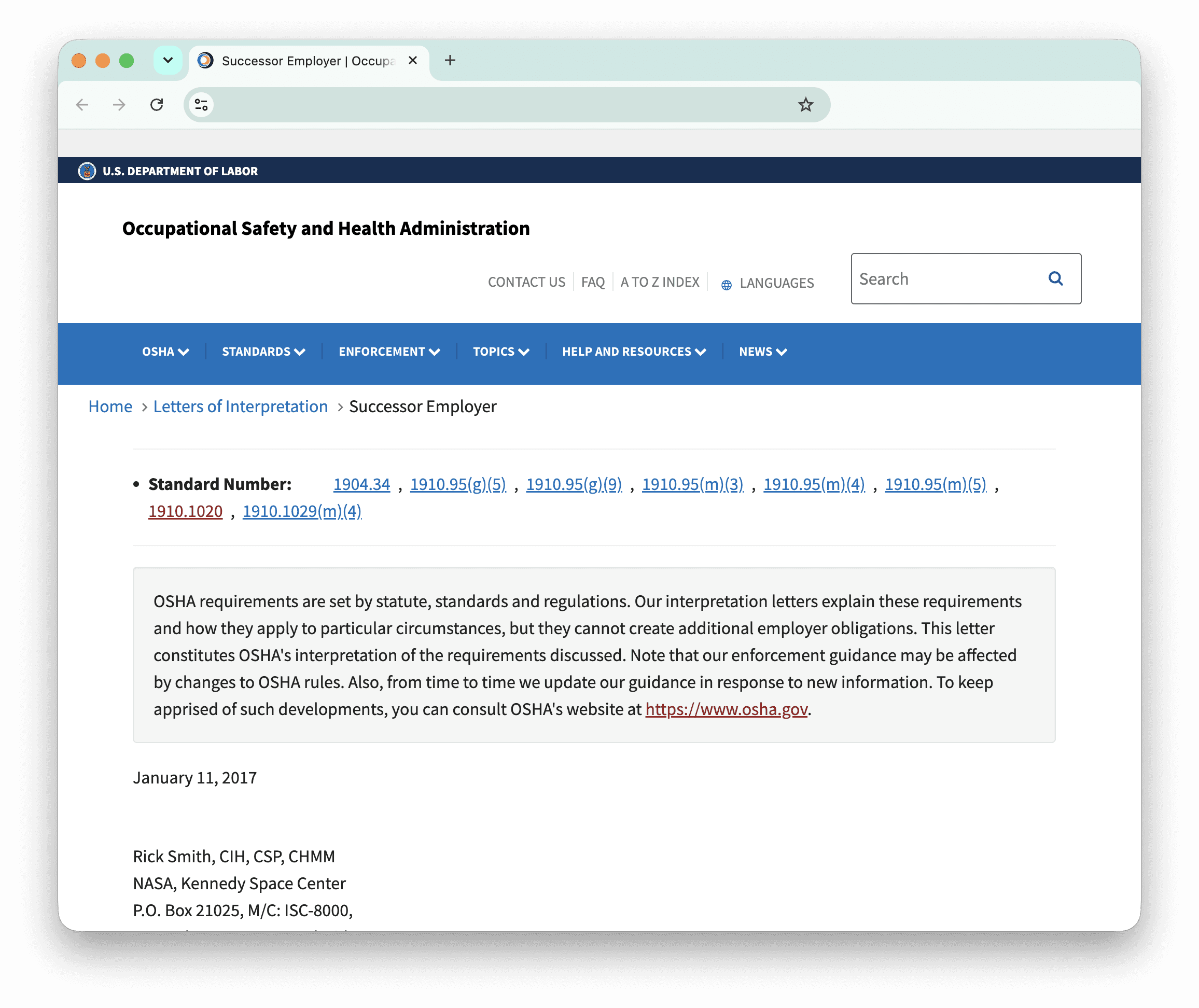
Source: Legal regulation document from the OSHA Standard Interpretations Database.
The Cal/OSHA Successor Liability Trap: Understanding The Core Risks
In corporate law, a fundamental rule of an asset purchase is that the buyer acquires specific items (like equipment or intellectual property) while leaving the seller’s historical legal liabilities behind. Cal/OSHA effectively ignores this standard corporate boundary by heavily enforcing the "substantial continuity" doctrine.
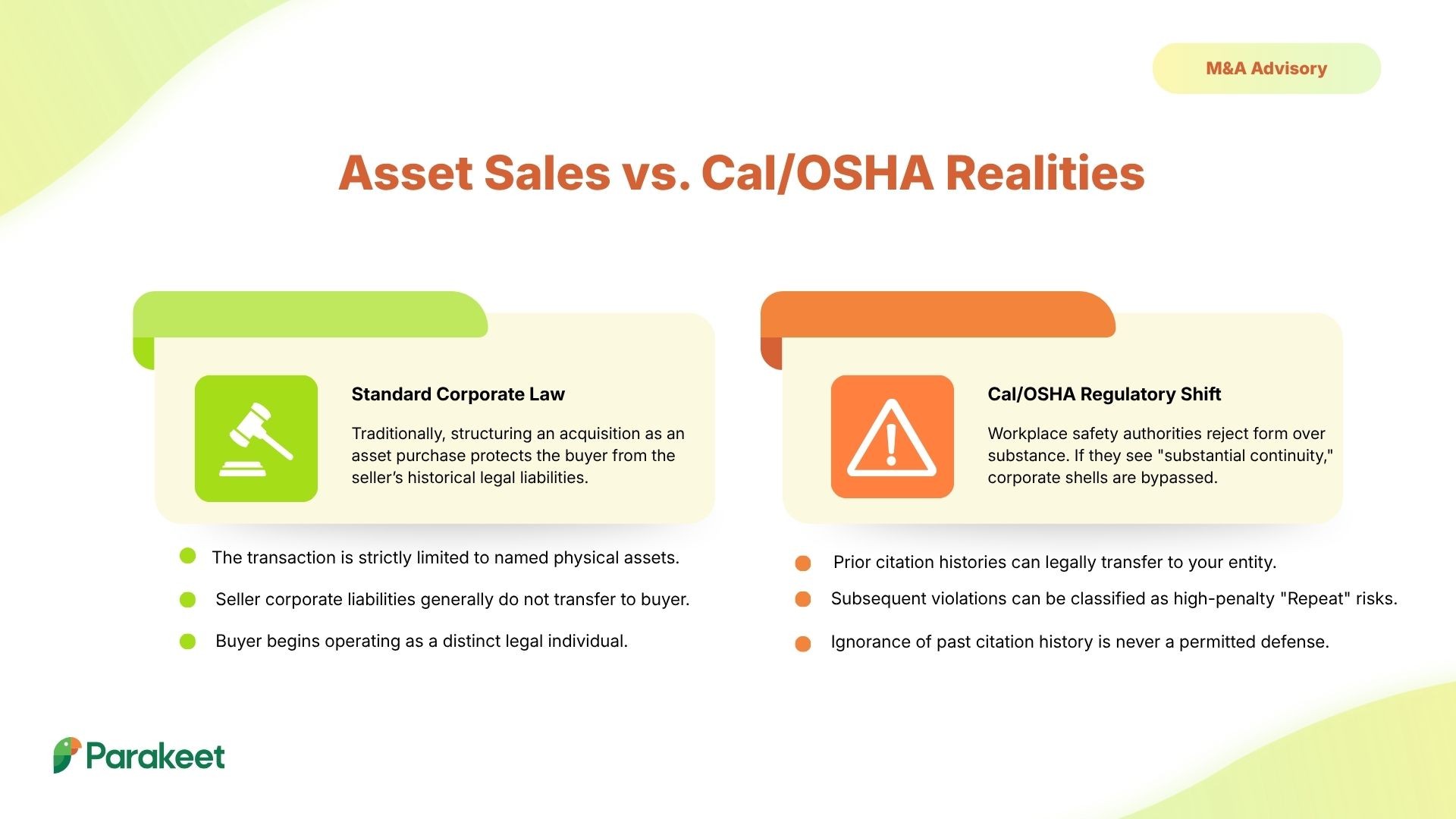
If you buy a company’s physical assets but continue operating the business in a similar manner, Cal/OSHA legally treats you as the original employer for safety enforcement, citation history, and repeat violations.
🛡️ Cal/OSHA Citations: Is Your New Facility Inheriting Someone Else’s Liability?
In California, a successor business can inherit the Cal/OSHA liabilities and "legal persona" of its predecessor. This aims to prevent employers from dodging severe safety violations, uncorrected hazards, and hefty fines simply by reorganizing, changing the company name, or undergoing a standard asset sale.
Courts will hold a new company accountable if it’s essentially a “mere continuation” of the old business or if the transaction is designed to evade debts.
This recorded webinar, available on the OSHA Defense Report, focuses heavily on successor liability under the OSH Act. It breaks down the safety and health obligations an acquiring employer assumes from a predecessor.
Under California law, successor liability can arise in specific situations—especially when a buyer purchases substantially all of a business’s assets or when multiple parties are involved in the transaction. Even if the sale includes several separate business locations operated by the predecessor, each location is treated as a distinct entity, and liability can apply to all.
Let's examine how these rules apply in the real world.
Imagine this scenario: You are a risk manager for an industrial manufacturing plant in California. Your parent company recently finalized an asset purchase, acquiring a facility with high-output production lines, heavy machinery, and a pre-trained workforce. The transition seemed seamless until a Cal/OSHA compliance officer arrived and handed you a citation.
Now, what if you brought in new contractors who fill the same roles, perform the same tasks, and use the exact same equipment as the previous team? Regulators will see this as a direct continuation of the previous operation. Simply changing the contract on paper won’t erase the past. Authorities can spot a new vendor’s logo, but they also see that the day-to-day work hasn’t changed.
Because of this, OSHA may determine that the new contractor is a successor under the Occupational Safety and Health (OSH) Act.
In other words, as the new employer, you inherit responsibility for the previous owner’s workplace safety record and any violations.
⏳ How the "Substantial Continuity" Test Determines Liability
Unlike traditional corporate law—where asset purchases generally leave liabilities behind—federal labor and employment law uses a much broader standard. The Occupational Safety and Health Review Commission (OSHRC) and federal courts apply what's called the "Substantial Continuity" Test.
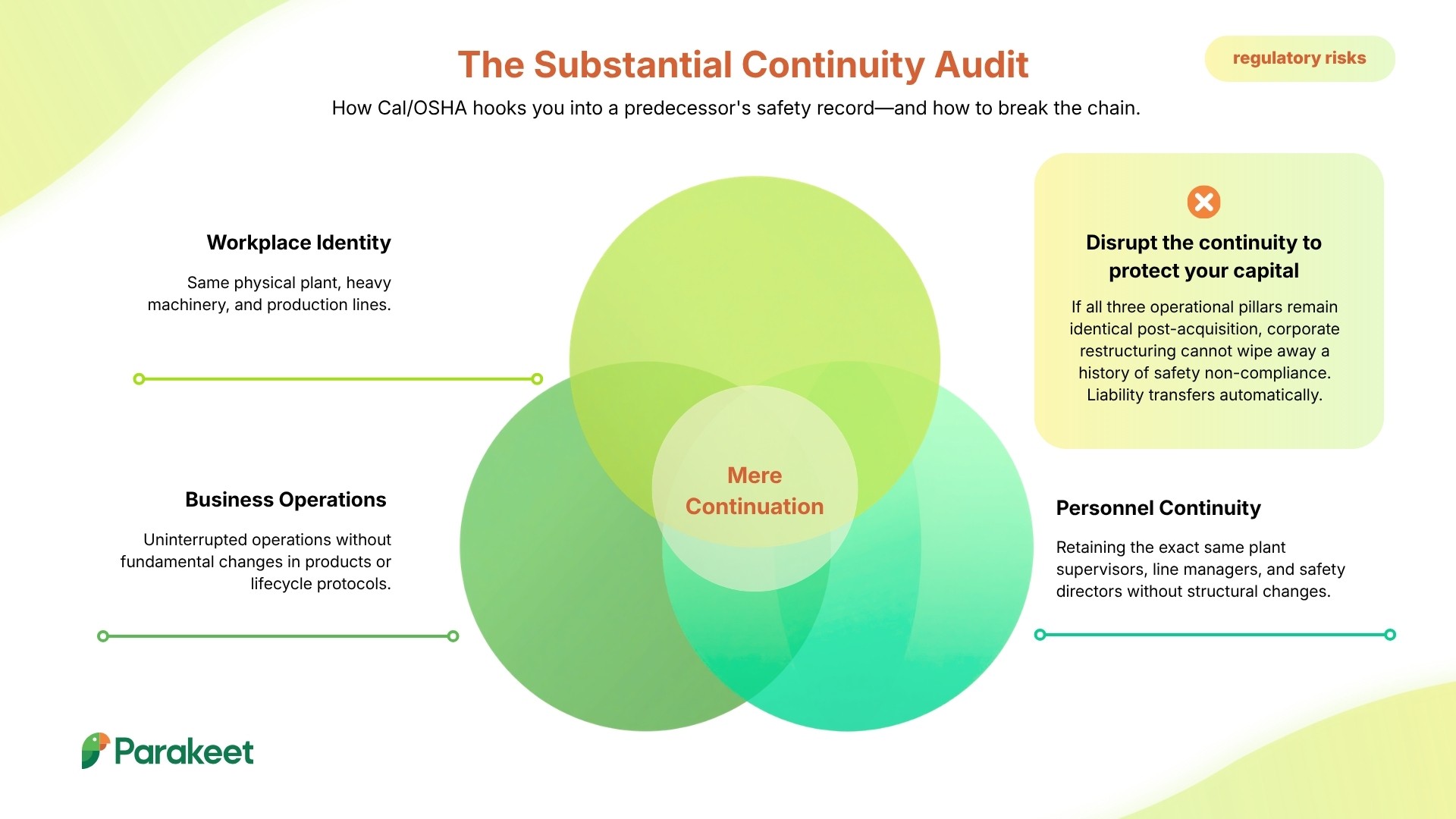
This means that if a company takes over another and keeps its business running with little disruption, it's considered a "successor employer." Regulators look at the whole picture, focusing on three key areas:
Operational Continuity: Are the same facilities, equipment, and production methods still in use?
Workforce Continuity: Does the new company keep the same supervisors, managers, and frontline workers?
Safety Control Continuity: Are the same people managing workplace health and safety programs?
As a risk manager, you must understand OSHA and workplace safety industry-specific standards to manage risk exposure.
💡 Strategic Risk Tip:
In California, the "Product Line Exception" means that even changing the company name won’t shield you if you continue making the same product line, as liability for past defects or hazards can still apply. To avoid this, it's best to deliberately break the chain of continuity by documenting a clear safety reset and rebranding the facility to show the new operation is truly different.
—> Read more about safety compliance key concepts and strategies essential for industrial buyers
🏭 Workplace Safety and Environmental Liability Under OSHA & EPA
The U.S. Environmental Protection Agency (EPA) and OSHA are increasingly holding new business owners accountable for the safety and environmental mistakes of the previous operators. In industrial settings with high risks, this means your new operation could be responsible for:
Process Safety Management (PSM) and Risk Management Program (RMP) Violations: Any unresolved issues related to hazardous chemical handling or emergency plans from the previous owner don’t just disappear when ownership changes.
Updated TSCA Restrictions: Outdated chemical handling or disposal practices used by the former owner can trigger immediate enforcement actions under the strict Toxic Substances Control Act regulations.
California M&A: Navigating the Cal/OSHA Successor Liability Trap
When Cal/OSHA determines that your newly acquired business has "substantial continuity" with the old one (because you kept the same facility, the same workers, and the same managers), you are legally deemed the exact same employer in the eyes of the law. You do not start with a clean slate.
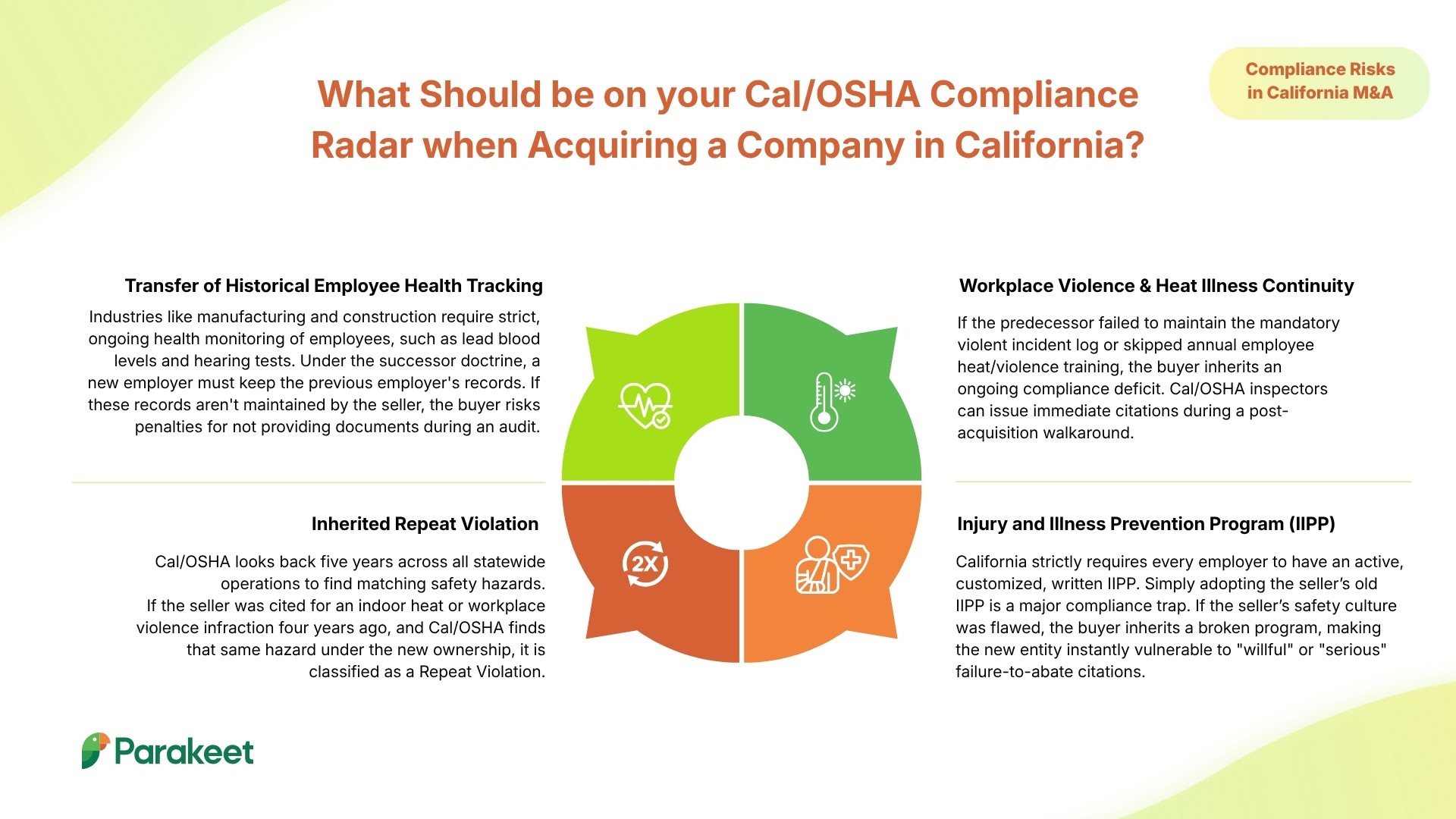
💰 Multiplied "Repeat" Violation Fines
Because Cal/OSHA views you and the predecessor as a single continuous business, their violation history becomes your violation history.
OSHA can issue Repeat Citations to the new owner based entirely on violations attributed to the previous owner. These repeat violations carry hefty penalties, reaching up to $165,514 per instance—about ten times the cost of a standard serious violation. If the new management keeps the same unsafe conditions or hazards in place, the successor inherits the previous owner’s regulatory "record."
Following the Department of Labor's 2026 inflation adjustments, fines have reached unprecedented levels:
A typical Serious Violation can now cost up to $16,550 per incident.
A Willful or Repeat Violation penalty can soar to an eye-watering $165,514 per citation.
How the Risk Plays Out: Cal/OSHA has a 5-year statewide lookback window for "Repeat" violations. If the seller was cited for a hazard (like a blocked fire exit or unguarded machinery) four years ago at any of their California locations, and a Cal/OSHA inspector finds that same hazard under your watch, you won’t get a standard "Serious" fine. You will get hit with a Repeat Violation, which carries a massive, compounding penalty (often exceeding $158,000 per violation).
📁 Mandatory Record-keeping Transfers
Under California Code of Regulations (CCR) Title 8 § 3204, when a business is continued by a successor, the new employer legally inherits the absolute duty to maintain and preserve all historical employee medical and exposure records.
When you take over a business, you’re not just inheriting the physical assets—you’re also responsible for keeping all the historical employee medical and exposure records intact. This includes important data like audiometric test results, air quality measurements, and chemical exposure logs, all protected under OSHA regulations (29 CFR § 1910.1020).
How the Risk Plays Out: If you keep the predecessor’s workforce (continuity of workforce), you are legally responsible for their historical health tracking—such as audiometric (hearing) tests or lead blood-level monitoring. If the seller kept terrible, incomplete, or non-existent health records, you are the one who will be cited and fined during an audit. Saying "I didn't own the company when those tests were skipped" is not a valid legal defense.
🌡️ Workplace Violence & Heat Illness Continuity
When operations are transferred without interruption, there is zero "grace period" for compliance.
How the Risk Plays Out: California has incredibly strict, active compliance standards for outdoor/indoor heat and Workplace Violence Prevention Plans (SB 553). If the predecessor was cutting corners and skipped the mandatory annual employee training or failed to keep an active violent incident log, that "compliance deficit" is transferred directly to you. An inspector walking into the facility on Day 2 can issue immediate citations to your new entity because your inherited workforce lacks the legally required training and documentation.
🩺 Injury and Illness Prevention Program (IIPP)
Substantial continuity often extends to maintaining the same safety processes and programs.
How the Risk Plays Out: Buyers often make the mistake of adopting the seller's existing, written IIPP just to keep things moving. However, if the seller had a broken safety culture, adopting their IIPP means you are adopting a program that doesn't actually match reality. If an accident occurs post-acquisition, Cal/OSHA will compare your actual practices to those inherited from the IIPP. Because you actively chose to keep using a flawed, inaccurate safety program, Cal/OSHA can easily elevate a standard citation to a "Willful" or "Failure-to-Abate" violation—which dramatically increases your financial and criminal liability.
For risk managers overseeing operations across multiple states, it’s essential to have a unified risk management and compliance framework that anticipates these successor liability challenges.
📋 Ongoing Abatement Requirements
If the predecessor company agreed to fix a safety hazard but sold the business before completing the work, the buyer must take over and finish the job. This responsibility applies to all locations the predecessor operated, even if they’re separate sites. The buyer or designated person must follow the rules and complete the required fixes.
Failing to meet these obligations can lead to liability for ignoring safety regulations. The buyer should know that interest and penalties may apply if fixes are delayed or incomplete.
If the buyer runs several business locations, each one is treated separately for liability purposes. So, successor liability in California applies to each site individually. The official notice of liability will include key dates related to enforcing these obligations.
Knowing these details helps avoid missing important responsibilities and ensures compliance with safety laws.
🧾 How not to Fall in the Tax Trap of Successor Liability?
In California, successor liability can also arise from unpaid state sales and use taxes under the Revenue and Taxation Code, creating buyer exposure for a predecessor's tax liability beyond workplace safety issues. For modern industrial operations, an unvetted state safety record or unpaid money owed is now an immediate deal-breaker.
You can remediate the shop floor perfectly, but still be haunted by the seller's unpaid state sales and use taxes. Successor liability extends into the Revenue and Taxation Code "in essentially the same manner" as safety violations.
The 3-Year Window: Note that under California tax procedures, written notice of liability must be served within three years of the business purchase. To protect yourself, you must:
Request a CDTFA Tax Clearance Certificate: This certificate from the board stating no outstanding debts exist protects you from possible liability.
Utilize Escrow Holdbacks: Withhold a portion of the purchase price until you receive that clearance. Without it, you or the person designated by the purchaser may be personally liable for the seller's tax debt.
While the threat of inherited liability sounds daunting, the legal playing field isn't entirely one-sided. The critical piece of leverage for an industrial employer is simple: the legal burden of proof does not rest on you. Cal/OSHA and tax boards carry the absolute burden to demonstrate they have cited the correct legal entity.
Furthermore, your plant team is under zero obligation to correct Cal/OSHA's administrative mistakes during an active inspection. If the division fails to establish a clear line of successor liability during their investigation, they cannot simply shift the blame to you later for their own misidentification.
⚖️ US Federal Enforcement vs. State-level Mandates
What's the difference between federal systemic enforcement and local physical mandates? The way a federal agency looks at an acquisition is fundamentally different from how a local state inspector views it:
US Federal Enforcement (OSHA / EPA/DOJ) | State-Level Mandates (Cal/OSHA / State AGs) | |
|---|---|---|
Scope of View | Focuses on systemic issues like ESG governance and enterprise-wide cyber/data risks (FCA). | Concentrates on factory-floor realities such as missing machine guards, unvented chemical tanks, and maintaining operational continuity. |
Vulnerabilities | Targets violations related to Process Safety Management (PSM), Risk Management Programs (RMP), and TSCA restrictions. | Addresses unpaid state sales/use taxes (CDTFA) and fundamental environmental, health, and safety (EHS) compliance. |
Deal Impact | Can threaten nationwide government contracts or label the company as a "repeat offender." | Can immediately halt transactions due to unresolved EHS issues, even without federal agreement. |
🛟 The DOJ Corporate Enforcement Policy (CEP) Lifeline
If you’re a buyer who uncovers serious problems—like falsified safety data or illegal chemical dumping—the United States Department of Justice (DOJ) offers a valuable lifeline through its M&A Safe Harbor policy.
The DOJ's M&A Safe Harbor policy is a specific legal protection program created and enforced by the Department of Justice for companies involved in Mergers and Acquisitions (M&A).
By voluntarily disclosing any misconduct from the previous owner, you can earn a "presumption of declination," which means the DOJ is less likely to take enforcement action against your company.
Timing is key to benefiting from this protection:
6-Month Disclosure Window: You need to report any criminal misconduct within six months after the deal closes, regardless of whether you discovered it before or after signing.
1-Year Fix-It Period: From the closing date, you have one year to fully address all physical and compliance issues, make any necessary restitution, and overhaul any broken safety systems. Meanwhile, California’s tax successor-liability rules require written notice of liability within three years of the purchase.
For industrial or chemical facilities, this one-year deadline to resolve complex hazards can feel tight, but it is crucial.
Meeting these requirements successfully grants you the Recidivism Shield, protecting your company’s reputation and future government contracting opportunities by ensuring legacy violations don’t count against you.
📝 How to Mitigate Successor Liability Risks? The Playbook for Industrial Risk Managers and Facility Buyers
To protect yourself, it’s important to understand that the successor may need to withhold part of the purchase price to cover these obligations. This responsibility is especially relevant for corporations and requires careful review of property and note agreements. Being aware of key deadlines for withholding and obtaining tax clearance certificates can help you avoid unexpected financial surprises down the road.
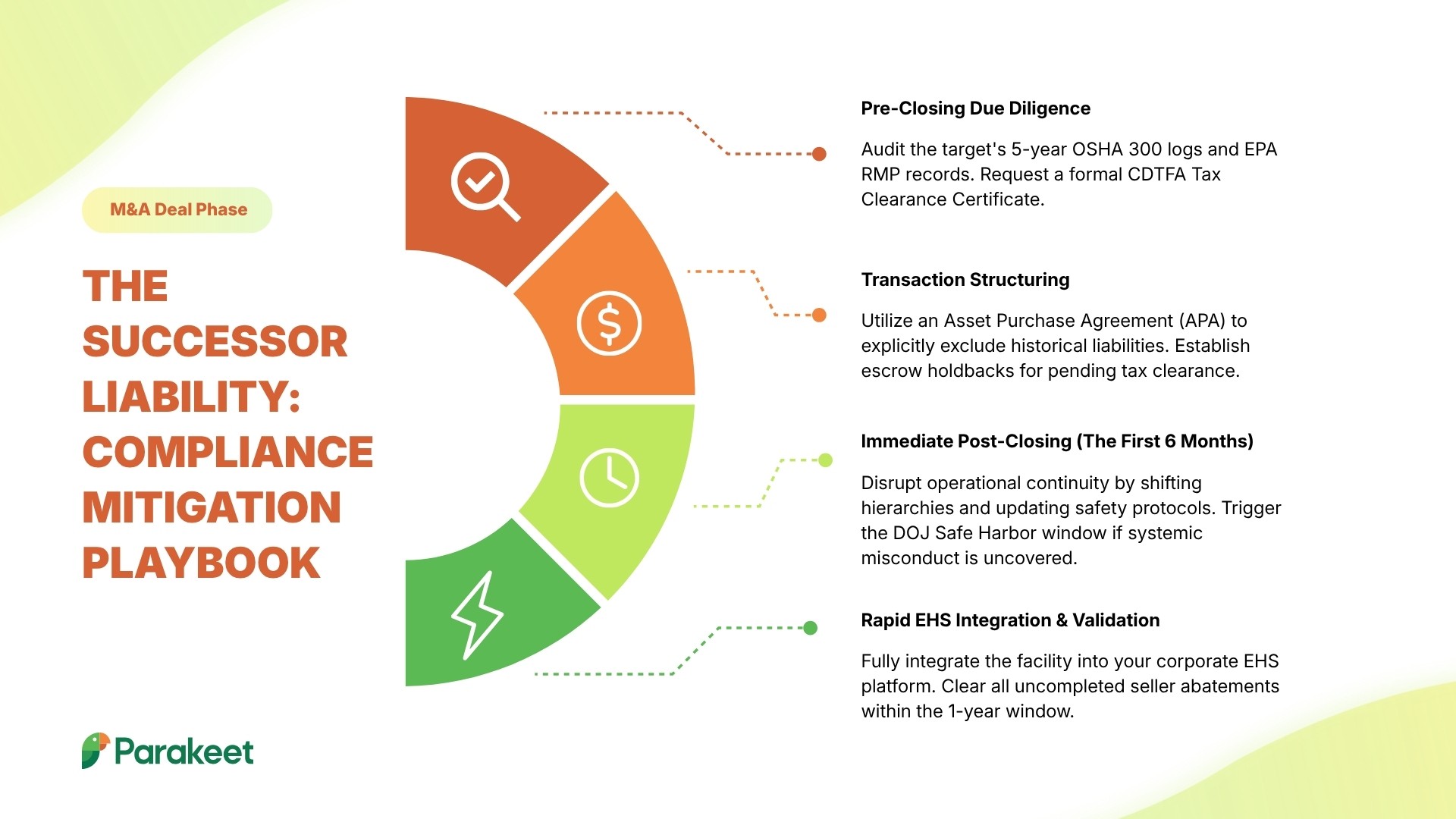
Buyers must perform thorough legal and financial due diligence. To block undesired liabilities:
Use an Asset Purchase Agreement (APA): Draft the agreement so it expressly lists the assumed liabilities while explicitly excluding all others.
Obtain Tax Clearance: Request tax clearance certificates (e.g., a CDTFA Tax Clearance) before releasing all escrow funds to the seller.
Escrow Holdbacks: Withhold a sufficient portion of the purchase price in escrow to cover potential contingent or unknown tax liabilities.
Extending these practices into your supply chain through automated supplier due diligence workflows further reduces the chance that hidden regulatory or safety failures at vendors will become your problem post-close.
💡 Strategic Risk Tip:
Implementing an integrated AI-powered risk and compliance platform helps centralize safety data, automate documentation, and maintain consistent successor-liability controls across facilities.
How to combat strict successor liability when expanding or restructuring industrial footprints? Remember about integrating structural safety nets across all three phases of the deal cycle. Before locking in any transaction structure, extend your due diligence to the vendor ecosystem by running a structured industrial third-party risk assessment program on critical contractors and suppliers.
Mitigation Phase | Required Action Element | Expected Compliance Outcome |
|---|---|---|
Pre-Closing | Go beyond basic checks by performing thorough due diligence. This includes auditing the past 5 years of OSHA 300 logs, reviewing EMR (Experience Modification Rate) ratings, and examining EPA RMP records. Legal counsel should also assess potential California successor tax exposure and determine if any portion of the purchase price needs to be withheld to cover the seller's tax liabilities. Be sure to submit any necessary written request for a tax clearance certificate. | This process helps uncover hidden safety hazards, unresolved citations, or looming penalties (which can reach up to $165,514 for repeat violations) before finalizing the valuation. Obtaining the tax clearance certificate after the request can release the buyer from further obligation regarding the seller’s tax liabilities. |
Transaction Structure | Isolate high-risk business lines, modify production protocols, or deliberately restructure the facility management hierarchy. In an asset purchase agreement or related purchase agreement, confirm clear title to assets as part of liability-control planning. | These steps help break the "substantial continuity" link, ensuring that the post-deal business does not simply replicate the predecessor’s operations, reducing the risk of inheriting liabilities. |
Post-Closing | Quickly integrate the acquired facility into your company’s standard Environmental, Health, and Safety (EHS) risk program. | This demonstrates to inspectors that you’re committed to compliance, addresses any physical safety gaps like guarding or lockout/tagout (LOTO), and helps maintain eligibility for protections like the DOJ’s M&A Safe Harbor. |
—> Schedule a demo of Parakeet Risk to automate compliance onboarding and third-party risk, and explore our industrial compliance solutions for manufacturers and processors.
To avoid inheriting serious workplace safety liabilities during a corporate transaction, buyers should follow this practical approach:
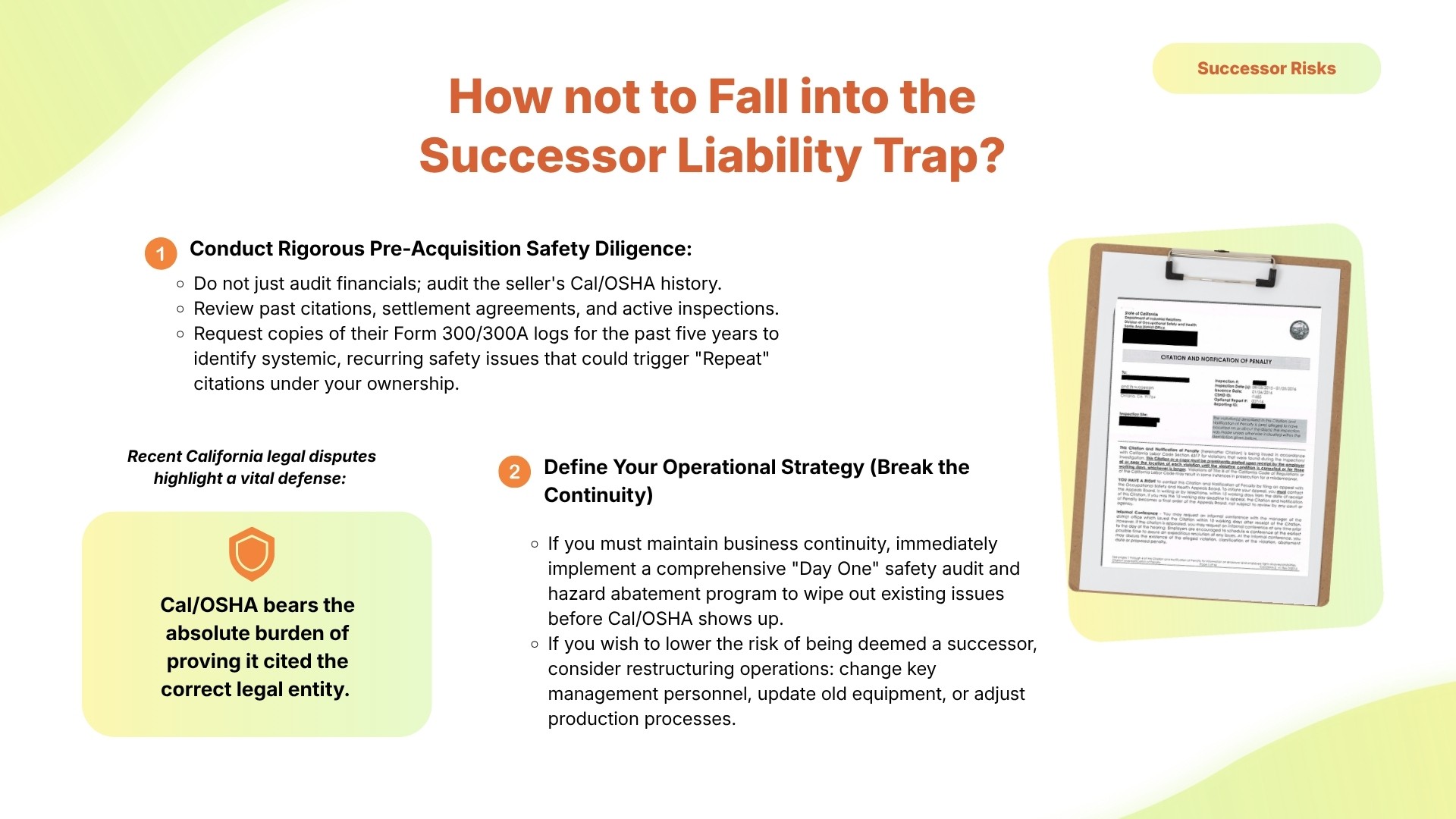
Review Past Safety Records: Carefully examine the target company’s OSHA 300 logs, previous citations, and any ongoing investigations using the OSHA Establishment Search Tool.
Assess Current Hazards: Bring in an independent certified safety professional to inspect the facility for any unresolved structural, chemical, or electrical risks before finalizing the deal, and backstop this with a robust contractor prequalification process for any third parties who will work on site.
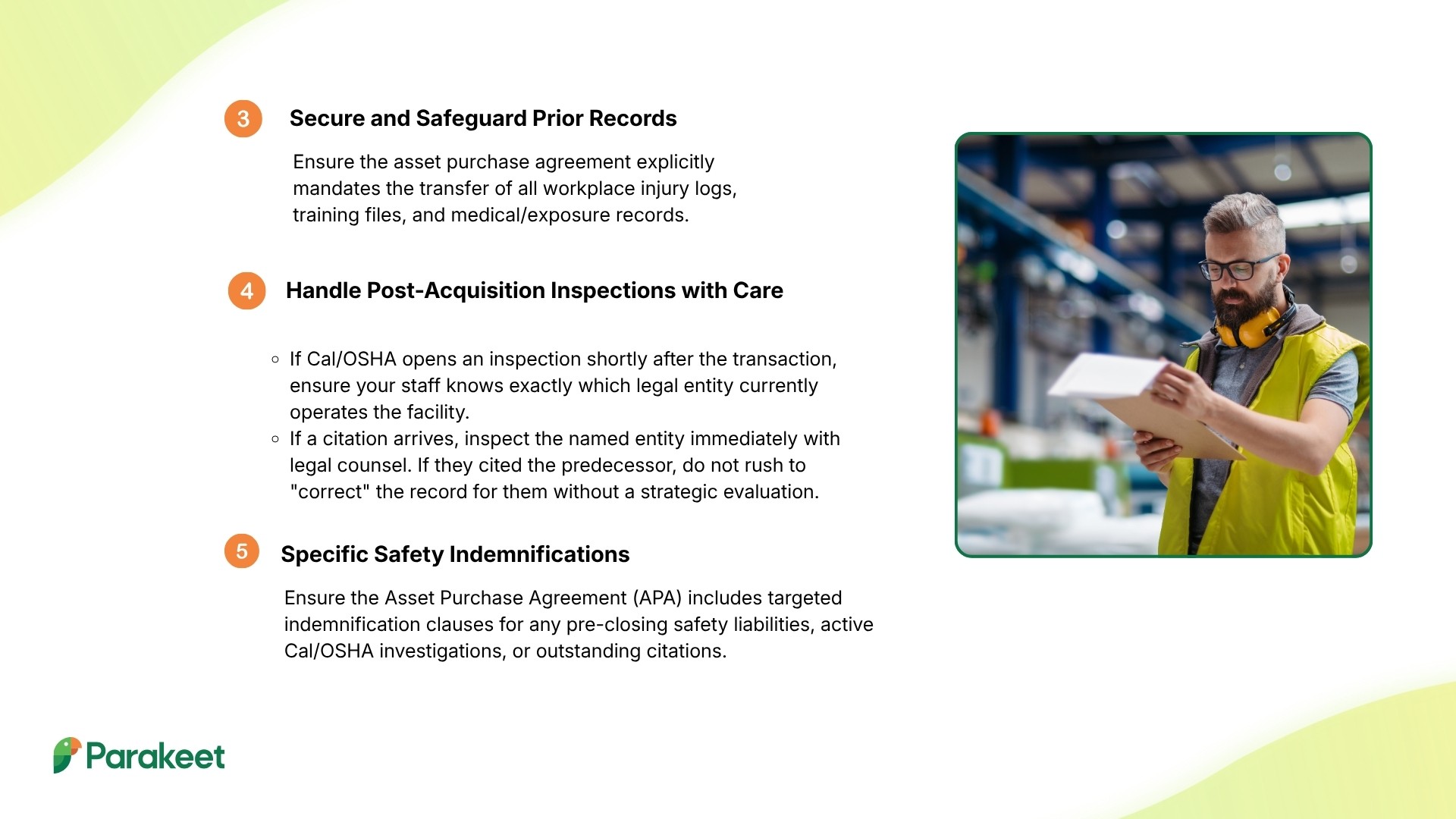
Craft a Clear Purchase Agreement: Include specific health and safety indemnification clauses. Use any identified risks to negotiate a fairer purchase price or set aside escrow funds for necessary hazard fixes, and align these provisions with your broader manufacturing compliance obligations.
Break Operational Continuity: Immediately after acquisition, make meaningful changes such as facility upgrades, revamping safety management, and launching new safety training programs to reduce the chance of repeat citations, supported by an AI risk assistant for compliance workflows.
The 2026 Successor Liability Takeaways: From Inherited Risk to Operational Excellence
The regulatory landscape in 2026 brings a clear message: when you acquire a facility, you also take on its regulatory history. Successfully growing your industrial operations requires thorough due diligence. This means treating a facility's safety record with the same care and attention you give its financial projections. By carefully reviewing a target facility's past safety performance and staying current on broader risk and compliance trends for industrial sectors, you can ensure your company gains a valuable asset ready for growth—not a hidden liability that could lead to costly penalties.
Sources: