Perspectivas Industriales
3 mar 2026
Women in Industrial Settings: Data on Representation, Safety and Leadership

Magdalena Rucińska
Content Specialist
Women remain significantly underrepresented across industrial sectors — construction, manufacturing, energy, and skilled trades — yet their participation is climbing to historic highs. At the same time, research increasingly shows that gender diversity in these sectors correlates with stronger safety records, better financial performance, and reduced workplace violations.
Beyond Equity: The Strategic Role of Women in Industrial Risk
What makes this conversation especially timely is that the industry is finally connecting the dots between workforce composition and risk outcomes. For too long, "diversity" was treated as a standalone HR initiative — something separate from operations, compliance, or safety culture. But the data tells a different story. When women hold decision-making roles in risk management and safety leadership, organizations tend to build more systematic, process-driven safety cultures. They ask different questions, challenge assumptions, and often flag hazards that go unnoticed in homogeneous teams.
For years, the conversation around industrial safety focused almost exclusively on better equipment, stricter compliance frameworks, and new technology. As the industry evolves, the narrative is finally shifting to reflect what the data actually shows. The growing presence of women in industrial roles is not merely a social equity issue but a crucial driver of business performance and risk mitigation.
This report compiles key statistics across workforce participation, workplace safety, leadership, and the business case for inclusion.
The Gender Gap in an Industrial Setting: What's Keeping Women Out?
So why are women still so underrepresented in manufacturing — and in industrial sectors broadly? A big part of the answer comes down to outdated perceptions. Manufacturing still carries an image problem: physically demanding, male-dominated, and unwelcoming. Those assumptions put women off before they even apply.
But the issue doesn't stop at the door. Many women who do join the industry end up leaving. The reasons are consistent:
poor workplace relationships,
limited promotion opportunities,
and pay that doesn't match their male colleagues.
What makes this especially frustrating? The problem isn't the work — it's the conditions.
Pay is a particular sticking point. More than 70% of women in manufacturing believe a gender pay gap exists in their workplace — and 100% of them say it favors men.
According to the Pew Research Center, women across U.S. industries earn approximately 85 cents for every dollar men earn — a gap that has barely moved in two decades.
Source: Pew Research Center Analysis
When we talk about attracting top-tier talent to manage complex industrial risks, we have to acknowledge these structural disparities. Pay inequity poses a retention risk that actively deters the very safety leaders, engineers, and compliance experts companies need to build resilient operations and strong safety cultures.
The industrial workforce gap isn't just a diversity issue—it's an operational one
More than 500,000 manufacturing jobs currently go unfilled, and the pressure is set to intensify.
A study by Deloitte and The Manufacturing Institute found that 2.7 million baby boomers would retire and approximately 2 million jobs would go unfilled between 2015 and 2025.
Phased retirements buy time, but they don't solve the underlying pipeline problem. The industrial sector needs a proactive strategy, and recruiting and retaining women is one of the most direct levers available.
The barriers are often cultural and systemic. Closing the gap means:
boosting the visibility of women already in leadership,
eliminating the conditions that make women leave (including pay inequity, limited advancement, and inflexible work arrangements),
and building genuine development pathways through mentorship and access to high-visibility projects.
Diverse teams make smarter decisions and drive better financial results
The business case for doing so is well-established. Companies with greater gender diversity consistently demonstrate more balanced organizational management, broader perspectives in decision-making, and stronger financial performance. In manufacturing, where operational complexity is high and the margin for error is low, those advantages aren't abstract—they translate directly into how problems are identified, how risks are escalated, and how teams hold up under pressure.
A few practical steps that make a real difference:
Make female leaders visible — in job postings, on panels, in company communications
Offer flexible working arrangements
Create clear paths to challenging, career-building projects
Build mentorship programs that connect women across levels
Actively close the gender pay gap
Offer competitive pay and benefits that reflect the value of the work
Companies that follow through on them consistently see stronger teams, better decision-making, and more resilient operations. In a sector where getting things right under pressure matters, that's not a small thing.
Is Female Representation in Construction Up?Progress at the Office, Gap on the Front Line
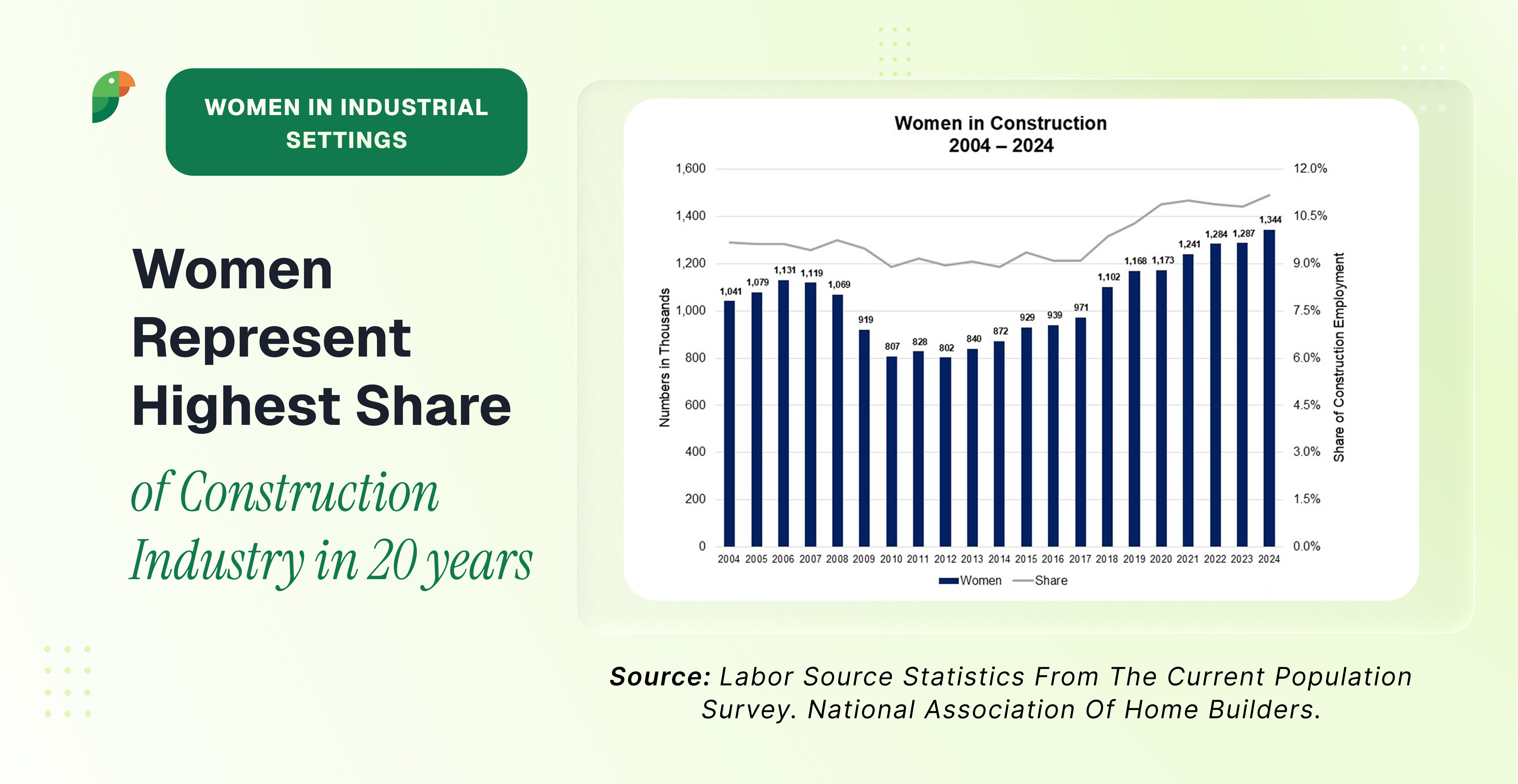
In the U.S., women make up roughly 11–12% of the construction workforce, the highest share in more than two decades. The construction industry has reached a milestone in women's representation, though deep disparities persist between office-based and field roles.
More Women in Construction — Just Not Where the Risks Are
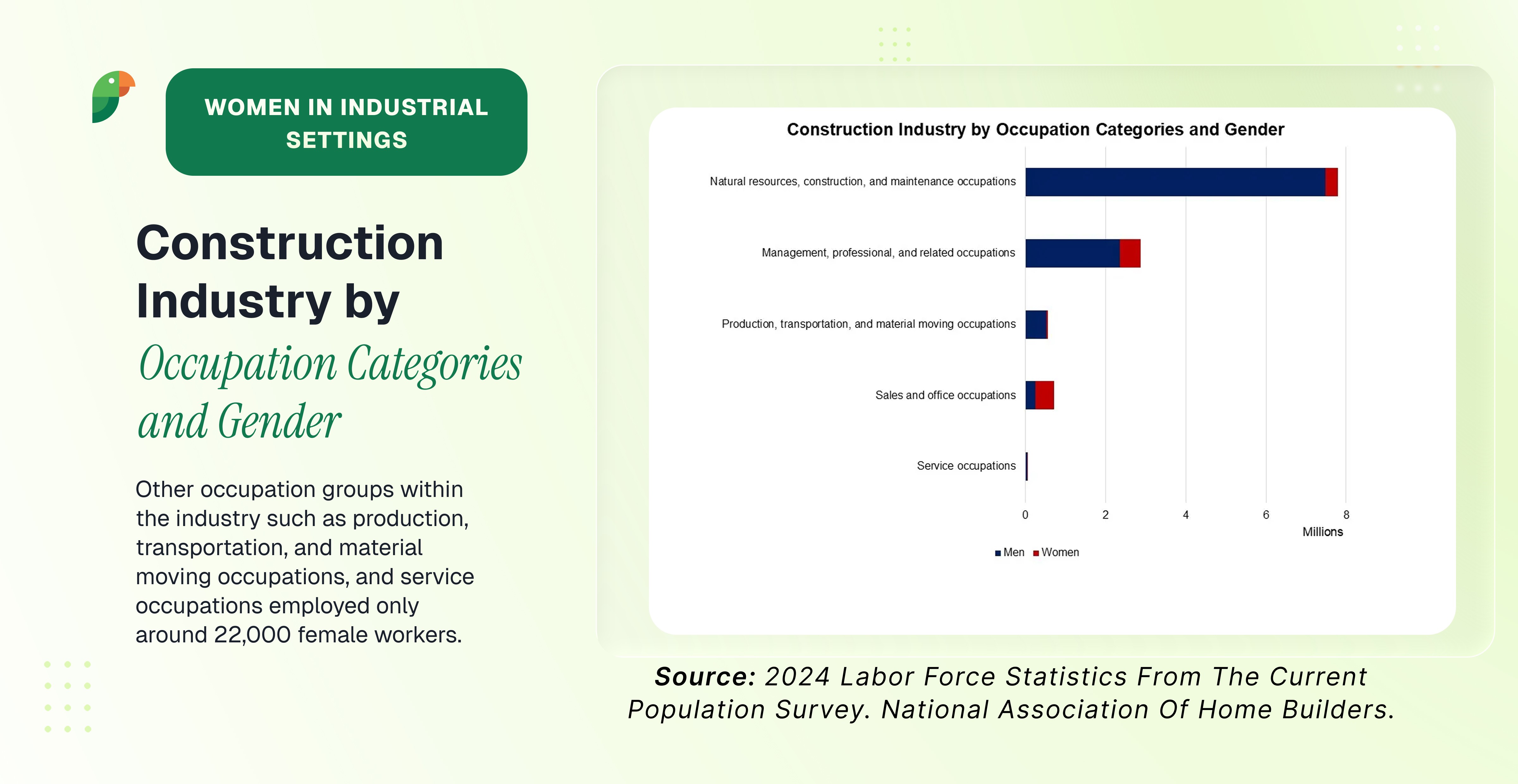
Yet where many of the industry’s biggest labor gaps sit—hands-on trade and maintenance work—representation is still strikingly low. Women are about 4.3% of construction trade workers and around 3–4% in maintenance/repair and construction/extraction positions.
Source: eyeonhousing.org
Women now make up approximately 11–12% of the U.S. construction workforce, the highest share in over two decades, with approximately 1.34 million women employed in the sector as of 2024.
The number of women working in construction and extraction trades hit an all-time record of 366,360 in 2024 — a 77.3% increase since 2015.
Despite this growth, women represent only 4.3% of construction trade workers (carpenters, electricians, plumbers, etc.) and just 3.1% of production roles.
Women make up 81.4% of the construction industry's office and administrative roles.
In management, women occupy only about 18% of all positions despite representing a growing share of the professional workforce.
Here’s what this actually means for risk and operations: progress is happening, but it’s not evenly distributed across job types. It’s incredibly lopsided. Many organizations are “adding women” primarily in office functions, while the highest-exposure roles—where injury risk, regulatory scrutiny, and operational disruption often concentrate—remain underserved.
Where Growth Stalls: Women in Manufacturing Leadership
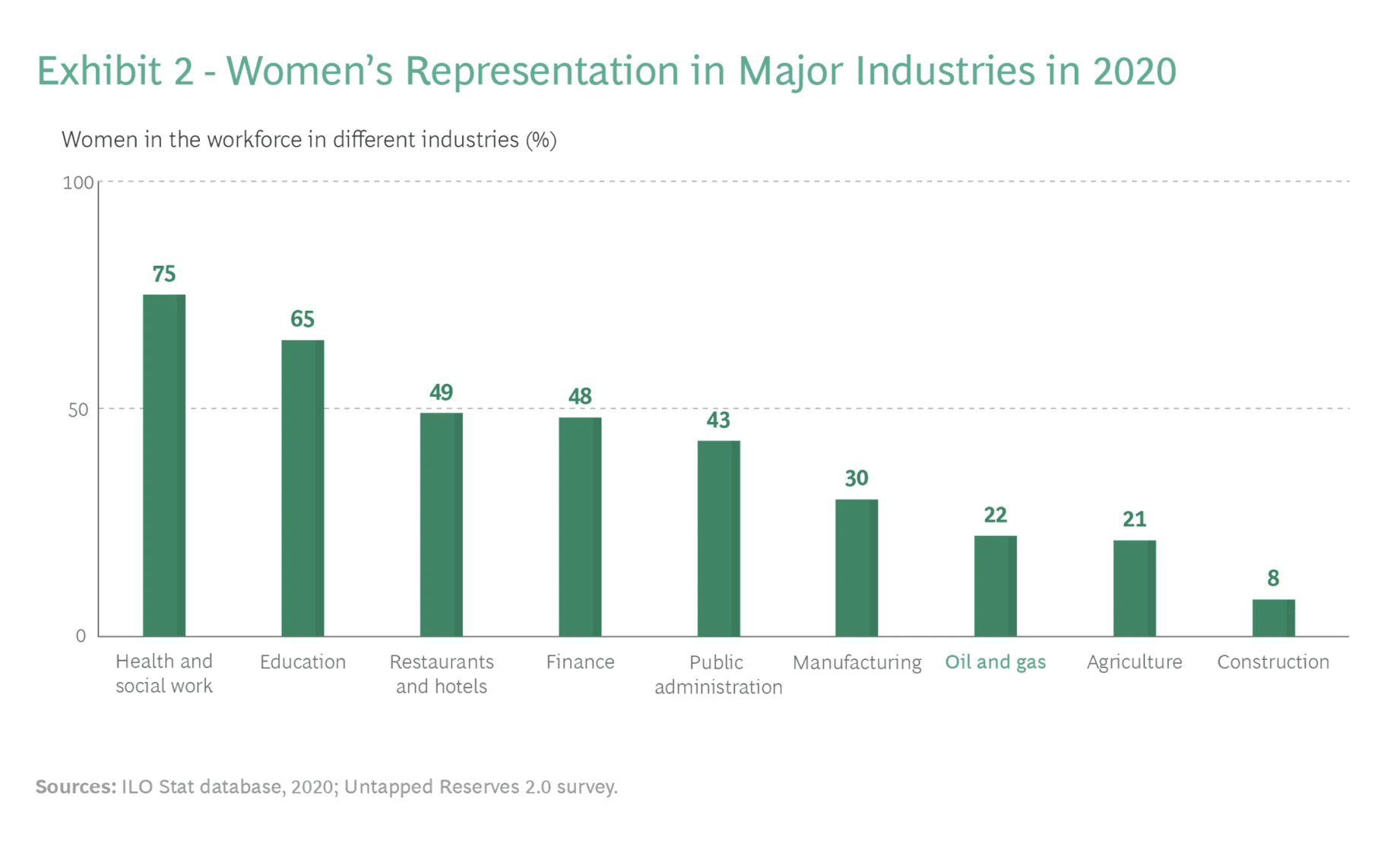
Manufacturing shows a familiar pattern: steady gains from a low base, alongside clear drop-offs in advancement and influence. Women comprise about 29% of the U.S. manufacturing workforce, even though they represent close to half of the overall labor force—so the participation gap isn’t subtle.
Women comprise approximately 29% of the U.S. manufacturing workforce, despite making up nearly half the total labor force.
Only 12% of manufacturing leadership roles in the U.S. are held by women.
That gap becomes even more pronounced in decision-making roles. Only 12% of manufacturing leadership roles in the U.S. are held by women, which matters because leadership representation influences everything from hiring targets and training investment to safety priorities and retention strategies.
Female Representation in the Energy Sector
The energy industry tells two very different stories depending on which part of the sector you're looking at — and that split matters enormously from a risk and talent perspective.
Globally, women account for just 22% of the oil and gas workforce, a figure that has been essentially unchanged since 2017.
Meanwhile, in the U.S., women represented 25% of the total energy workforce in 2022 — a 17.2% increase from a decade earlier, according to the Center for American Progress — signaling that the pipeline is at least expanding.
Leadership remains the pressure point: women hold only 15.6% of leadership roles in Oil, Gas, and Mining, placing the sector among the lowest in the industry and reinforcing the “leaky pipeline” dynamic from entry to executive roles.
The pattern is consistent: women enter the industry, but tend to cluster in support functions rather than advancing into the roles that carry the most operational weight and risk exposure.
Diversity isn’t just about culture—leadership mix can predict safety outcomes
The inclusion discussion often stalls at awareness campaigns or hiring goals. But there’s growing evidence linking women in leadership to improved workplace safety.
A 2025 peer-reviewed study (tracking 1,188 U.S. firms over 19 years) found that companies with at least two women executives were 14.3% less likely to experience safety violations and faced penalties that were 13.9% lower than average. The study also reported stronger effects when firms had women on boards and when investors supported women’s leadership.
The safety benefits were even stronger in companies that also had women on their boards and institutional investors advocating for women's leadership.
Companies with higher gender diversity are 39% more likely to outperform their peers financially.
Women in Safety and Leadership Roles
Industrial sectors are operating under talent pressure, and construction is the loudest example. Some industry analyses estimate a gap of hundreds of thousands of workers needed to meet demand, positioning women’s participation as a practical labor solution—not a side initiative.
Just 19% of workers in the safety and health industry are women, compared to nearly 50% of the overall U.S. workforce.
In construction specifically, women's leadership representation is the lowest of any major industry at just 11.0%.
Meanwhile, representation in “career-advancing” rungs continues to thin out. Global leadership statistics compiled across industries show women are overrepresented at entry levels and underrepresented at senior levels, with one widely cited metric: for every 100 men promoted to manager, only 81 women are promoted—creating a pipeline bottleneck that compounds over time.
Practical moves risk teams can lead (without waiting for culture change)
We have the data: gender diversity drives better safety records and stronger financial performance. Yet the reality on the ground hasn't caught up. To turn these insights into safer operations, risk professionals need to look past the surface-level progress and tackle the core bottlenecks:
Track role-level representation (not just total headcount)
Separate office vs. field, trade vs. supervision, and maintenance vs. admin so risk exposure isn’t hidden by aggregated DEI metrics.
Elevate safety governance expectations
Build routines where leadership regularly reviews safety data, corrective actions, and resourcing—because governance patterns are part of what the leadership-and-safety research is capturing.
While the influx of women into industrial trades proves the sector is evolving, true operational integration still lags behind. Persistent field-level gaps, a leaky leadership pipeline, and uneven safety policies expose ongoing vulnerabilities that risk managers must address. Embracing gender diversity is now a proven method for reducing workplace incidents, meeting strict compliance standards, and building fundamentally safer worksites.