
In this article
- The Biggest World Cup Pitch Transformation: Engineering the Natural Turf
- The Science Behind the Living Pitch Ecosystem: Overcoming Main Challenges
- What Technologies Ensure Consistent Grass Quality Across Diverse North American Climates?
- How did the NFL stadiums transform? The Anatomy of a High-Tech Pitch Aligned with FIFA's Technical Specifications
- Critical Logistical Risks Behind FIFA Pitch Transformation
- Player Safety and Biomechanical Risks
- Primary Safety Risks for Stadium Workers
The engineering behind the 2026 FIFA World Cup represents one of the most complex, high-stakes agronomic and logistical projects in sports history.
The complex infrastructure and planning of the FIFA World Cup required transforming existing stadiums into world-class soccer venues.
Because FIFA mandated that all matches be played on uniform natural grass surfaces, organizers had to convert eight multi-use stadiums (predominantly facilities that belong to the National Football League) from permanent artificial turf to live grass.
Key Highlights:
- The extensive modifications were needed to convert National Football League (NFL) stadiums, such as raising the playing surface, modifying corner seating to fit wider pitches, and replacing synthetic turf with natural grass.
- The advanced sub-surface engineering, including modular hybrid grass systems, "permavoid" bases for shock absorption and drainage, and the installation of giant LED and HPS grow lights to keep the grass healthy in enclosed stadiums
Accomplishing this across 16 host cities spanning three countries, nine climate zones, and varying elevations requires transforming the pitch from simple "farmland" into a highly calibrated piece of technology. However, the engineering behind this transformation presents severe logistical and safety risks.
The Biggest World Cup Pitch Transformation: Engineering the Natural Turf
The 2026 World Cup is officially the biggest ever staged, spanning 16 stadiums across three countries. But unlike past tournaments, you won’t find a trail of abandoned, custom-built mega-stadiums left behind. Instead, engineers have achieved an impressive sustainability milestone by retrofitting existing NFL, MLS, and Liga MX venues to meet FIFA’s strict standards. They’ve boosted stadium capacities and upgraded energy, water, and waste systems—all without leaving behind useless permanent structures.
With the FIFA World Cup returning to North America for the first time since 1994, organizers faced the huge logistical challenge of modifying existing stadiums. The biggest headache? Most NFL venues rely on artificial turf. Because of this, a total pitch transformation was vital to meet FIFA’s strict regulations and deliver a truly elite playing experience for the tournament.
The goal? To make sure a stadium in Mexico feels just like one in Canada underfoot. For the 2026 tournament, the pitches have become finely tuned living technology, with every detail meticulously tested before kickoff:
- Bounce & Hardness: Ensuring the ball behaves exactly as expected.
- Traction & Grip: Calibrated to minimize injury risks for players.
But that raises a critical question: How do you ensure that a turf farm in mile-high Colorado and another in rainy Washington state deliver a completely identical "industrial product" under wildly different climates?
To pull it off, engineers couldn't just rely on the old playbook.
Instead of simply dropping temporary sod over existing artificial turf—a method that caused the widely criticized "trampoline" effect during the 2024 Copa América—they took a more sophisticated approach with a "shallow pitch profile" module system.
The Science Behind the Living Pitch Ecosystem: Overcoming Main Challenges
The FIFA grass transformation was an engineering process that built a hybrid pitch that is 95% to 97% real, living natural grass. It is absolutely not an artificial turf field, nor is it just standard dirt and sod rolled out over concrete. Instead, it is a highly engineered, living ecosystem built from scratch inside multi-use NFL stadiums.
The core challenge is that these iconic US stadiums are essentially giant concrete venues designed for permanent artificial plastic turf. Forcing real grass into an environment like that required an unprecedented level of innovation.
In doing so, the concept of grass was totally redefined, turning the pitch into a true piece of technology: a carefully crafted, multilayered matrix. To truly grasp how this works, we need to look beneath the surface.
- The Multilayered System
First, the entire pitch is raised up to two feet above the original stadium floor. Directly beneath the green grass canopy lies a meticulously engineered stack: a 6-to-12-inch layer of silica sand rootzone, a binding transition layer, and a gravel drainage base. The secret weapon here, though, is a specialized vacuum-ventilation system. If a sudden downpour hits, it sucks out excess moisture in seconds; if the grass is suffocating, it pumps oxygen directly to the roots. - Locking It Together: Hybrid Stabilization
But a high-tech foundation doesn't matter if the turf rips apart the moment a player makes a sharp turn.
To prevent the sod from tearing under intense player movement, organizers are using hybrid stabilization. Giant machines stitch millions of synthetic fibers deep into the sand base. Think of these fibers like rebar in concrete—they intertwine with the natural grass roots, locking the field together so it can withstand intense rotational forces. The smart concept provides total stability while ensuring the surface remains 95% natural grass. - The "Pizza Slice" Transport Method
Of course, you can't construct a masterpiece like this overnight inside a domed NFL stadium. It has to be born somewhere else.
The grass is grown on 11 specialized turf farms across North America. To help it survive the grueling process of being moved, farmers cultivate it on top of giant plastic sheets. This forces the roots to grow horizontally rather than vertically. When match day approaches, the turf can be harvested and rolled up like a giant pizza slice—with its vital root system perfectly intact and ready for transport.
What Technologies Ensure Consistent Grass Quality Across Diverse North American Climates?
The grass is being cultivated at specialized off-site farms to exact specifications.
For instance,
Dallas's AT&T Stadium gets a precise Kentucky bluegrass and ryegrass blend grown in Colorado, while LA's SoFi Stadium sources its turf from Washington state.
Once ready, it is transported hundreds of miles under refrigeration to preserve its root system during transit.
However, keeping the grass alive after arrival presents an even greater engineering challenge. Living turf cannot naturally survive the rigorous demands of a 104-match tournament inside enclosed concrete domes.
That's why engineers must temporarily convert these stadiums into climate-controlled greenhouses. They did it by using giant LED grow-light rigs and massive air-circulation fans set up in the ceilings to sustain photosynthesis and soil health. Once the final match concludes, the entire ecosystem will be dismantled so the venues can revert to their standard synthetic NFL surfaces.
How did the NFL stadiums transform? The Anatomy of a High-Tech Pitch Aligned with FIFA's Technical Specifications
The perfect football pitch at the 2026 World Cup is not simply grass. It is a combination of agriculture, temperature control, engineering and logistics.
Source: Reuters
To meet FIFA regulations and accommodate the 2026 FIFA World Cup, National Football League stadiums underwent extensive engineering projects to convert their standard American football fields into world-class international soccer pitches. These transformations involved several major structural and agricultural modifications designed to create the perfect playing surface for the biggest World Cup event:
- Expanding Field Dimensions and Seating: NFL fields are much smaller than FIFA-regulated soccer pitches. To meet the required wider dimensions, construction teams removed and modified corner seating sections, replacing precast concrete seating with removable steel structures. The playing surface was also raised above the standard NFL field level to meet FIFA’s specifications.
Stadium operators and construction teams undertook extensive work to convert artificial playing surfaces into natural grass fields and reconfigure seating areas to accommodate the full-sized international soccer pitches required for the FIFA World Cup 2026. This process involved more than just laying down grass; it was a complex engineering and logistical feat.
To comply with FIFA regulations, stadium operators and construction teams have been working to convert playing surfaces and reconfigure seating areas to accommodate full-sized international football pitches.
These standards are meticulously designed to guarantee fairness, player safety, and the highest levels of performance. The technical requirements include:
- Strict Dimensions: For major tournaments, the field of play is standardized to a uniform size (e.g., 105 m × 68 m) to maintain consistency for players.
- Advanced Infrastructure: Stadiums are equipped with high-tech systems like underground aeration, heating pipes, and grow lights to maintain flawless natural grass throughout.
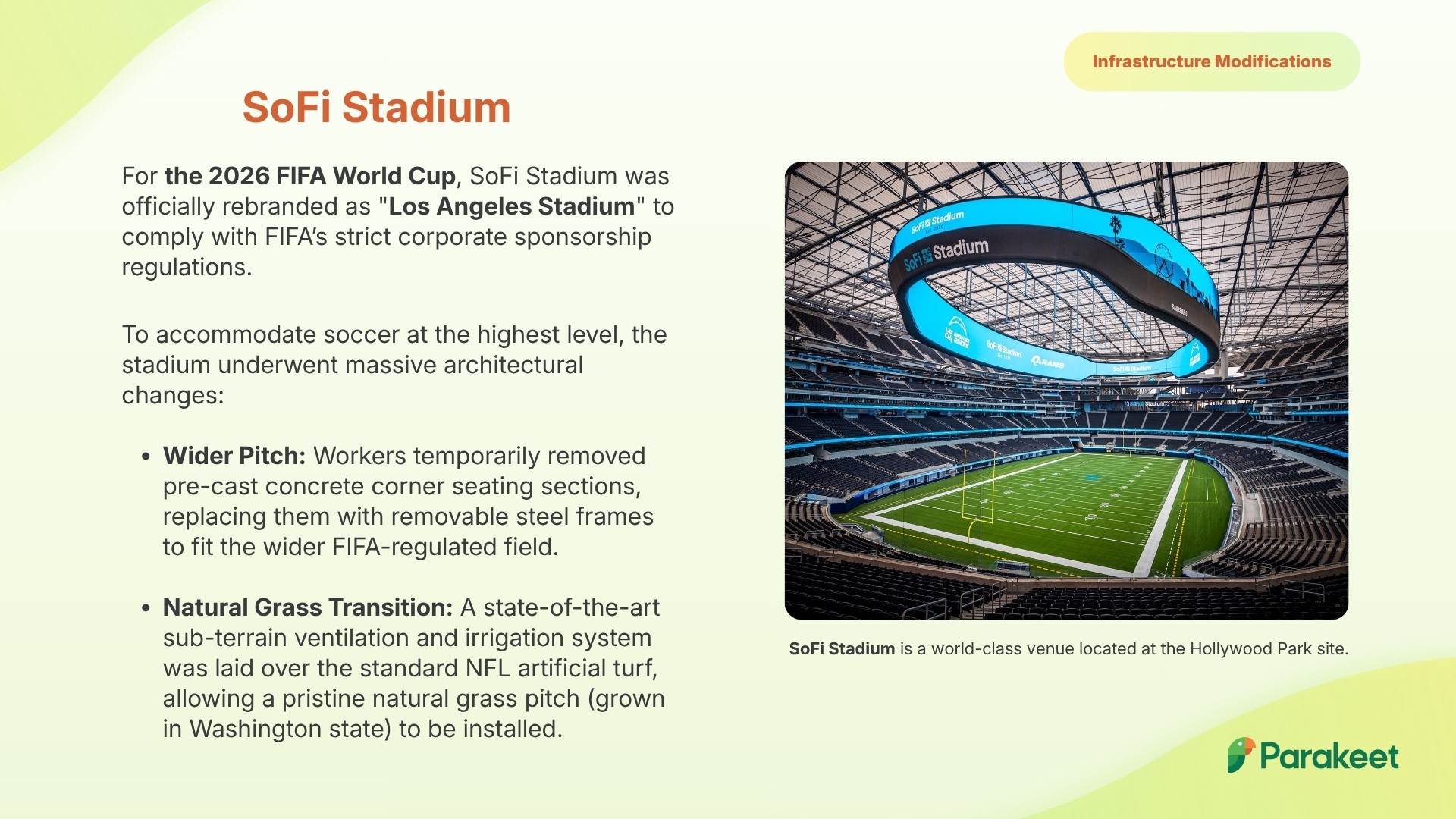
At SoFi Stadium in Los Angeles, one of the tournament’s key venues, the transformation was particularly intricate. Juan Carrero, Vice President of SoFi Stadium, explained that the FIFA pitch requirements differ significantly from those of the NFL.
The NFL field is much smaller than a FIFA-regulated pitch. The field elevation is also changing, with the World Cup playing surface sitting higher than the current NFL configuration. Corners of the stadium are being modified to create the required perimeter space and pitch dimensions.
Carrero added that the project has involved collaboration with a range of specialists to ensure the venue meets FIFA's technical standards for hosting World Cup matches. According to Rick Solomon, an executive with Clark Construction, preparations at SoFi Stadium actually began two years ago.
Critical Logistical Risks Behind FIFA Pitch Transformation
This logistical feat of replacing synthetic fields with natural grass involves transporting site-specific grass varieties over 1,000 miles and modifying stadium structures to accommodate wider pitches. The natural grass for SoFi Stadium is grown in Washington state and is transported over 1,600 miles to Los Angeles using a refrigerated transportation system.
The advanced underground irrigation and specialized LED grow lights that aim to support natural grass is a sudden, massive draw on power tests the limits of the stadium’s industrial electrical infrastructure. A failure of the third-party equipment providers or a localized power grid failure could kill the pitch within days, leading to catastrophic tournament delays.
Managing a living biological ecosystem inside concrete-and-steel entertainment stadiums introduces intense supply chain vulnerabilities:
- The Cold Chain Threat: Roughly 2 acres (84,000 to 87,000 square feet) of sod are needed per stadium. This requires a synchronized fleet of 27 to 30 refrigerated trucks per pitch traveling up to 1,200 miles (such as hauling cool-season grass from Colorado to domed stadiums in Texas and Georgia). If a truck's refrigeration fails or gets delayed in the summer heat, the grass rapidly decomposes and becomes unusable.
- Rapid Turnaround Strain: With an expanded format of 48 teams playing 104 matches, pitches face unprecedented traffic. Venues have incredibly tight windows to execute pitch maintenance, roll out grow-lighting rigs, and repair divots between matches.
Player Safety and Biomechanical Risks
The primary driver behind FIFA's engineering effort is protecting the athletes, as data shows players are 28% more likely to suffer non-contact lower-body injuries on artificial turf compared to natural grass.
Watch this breakdown of how sports scientists and turf engineers utilize specialized equipment to test surface hardness, bounce, and rotational traction to minimize player injury risks:
Fabricating a living ecosystem inside a giant concrete dome is a monumental engineering feat. However, this brilliant transformation is not free from technical and human risks. Beneath the high-tech veneer of these new pitches lies a demanding operational reality that presents genuine hazards to both the integrity of the playing surface and the safety of stadium workers.
If the technology or execution fails, the consequences directly impact the game and the athletes:
- Soft Tissue and Joint Injuries: If the surface density, traction, and grip aren't completely uniform across all 16 stadiums, players face a massive risk of muscle tears, ligament strains, or ankle injuries caused by unpredictable rotational forces.
- The "Trampoline" and Seam Effect: If the interlocking modular sections are not perfectly flush, or if the sand base shifts, it creates uneven seams and a faulty bounce—much like the widely criticized pitches during the 2024 Copa América.
- Biological Shock and Turf Death: Because the grass is living, transporting it over 1,600 miles creates a high risk of the turf dying before installation. Furthermore, if a stadium's artificial microclimate system (the hanging LED grow lights or vacuum ventilation) suffers a mechanical failure, the grass can suffocate and rot inside the concrete domes.
Primary Safety Risks for Stadium Workers
While the engineering behind the new pitches is highly sophisticated, the human cost of installing and maintaining these systems is a serious concern. Stadium workers—including construction crews, turf technicians, security personnel, and hospitality staff—face several distinct hazards during the tournament prep and matchdays.
- Extreme Heat Stress and Dehydration
Transforming concrete domes into temporary greenhouses requires an immense amount of energy and labor, often under grueling conditions.
Workers must spend long hours directly beneath massive, heat-emitting LED grow lights and high-powered lighting rigs, often in stadiums with restricted airflow during construction phases. The pressure to meet rigid FIFA schedules means crews frequently work extended shifts during peak summer temperatures, drastically increasing the risk of heat exhaustion, heat stroke, and preventable workplace fatalities.
Controversies Surrounding FIFA World Cup Natural Turf Quality
The pitch quality controversy during the 2026 FIFA World Cup represents the intersection of multibillion-dollar engineering and severe player frustration. Despite massive scientific and financial backing, the conversion of NFL stadiums from artificial turf to temporary natural grass has triggered a fierce modern football debate.
The NFLPA continues to highlight that players are forced to play on synthetic turf during the domestic football season, which increases the risk of injury, while billionaires willingly spend over $5 million per stadium to temporarily install pristine grass just to appease FIFA.
In summary, the transformation of NFL stadiums from artificial turf to natural grass for the 2026 FIFA World Cup involved a combination of advanced agronomic science, logistics, and engineering innovation. This effort ensures that every match is played on a surface worthy of the world’s most prestigious soccer tournament, reflecting FIFA’s commitment to excellence and player safety. However, as with any big endeavor, the pitch transformation is not free from risks.
Sources:
- https://www.reuters.com/graphics/SOCCER-WORLDCUP/GRASS/lbvgyqdnxvq/
- https://www.latimes.com/sports/soccer/story/2026-07-10/sofi-stadium-one-of-biggest-stars-of-2026-world-cup

Written by
The Parakeet TeamIndustrial risk insights from the Parakeet Risk team.
.jpg)