In this article
- Fall Protection is the Most Cited OSHA Violation
- OSHA’s #1 Violation: The Reality of Fall Hazards in Construction
- What are the OSHA fall protection requirements for the construction industry?
- Who Pays the Price for Fall Risks? Contractor Liability & Accountability
- The Three Phases of an OSHA Inspection
- 1. The Opening Conference
- 2. The Walkaround
- 3. The Closing Conference
- Recent Cal/OSHA Updates on Fall Protection Requirements
- The High Price of Height Hazards: Lessons from the Real-World Case
- Why OSHA Compliance Isn’t Enough to Mitigate Safety Liability
- Building an Efficient Fall Protection Plan
- Key Takeaways:
- Frequently asked questions
When hiring external subcontractors, their regulatory history, on-site behavior, and safety compliance directly affect the primary hiring company's liability, insurance premiums, and operational uptime. OSHA fall protection violations can result in large fines for exposing workers to heights without harnesses or guardrails.
Fall Protection is the Most Cited OSHA Violation
Falls rank as a leading cause of fatalities in the construction industry. For context, out of 5,486 total workplace fatalities recorded across all U.S. industries in 2022, 865 resulted from slips, trips, and falls—with 700 of those being deadly falls to a lower level. That’s why a comprehensive fall protection plan that protects all employees’ health and safety is essential for construction companies, contractors, and other employers whose primary responsibility is employee and colleague safety.
Compliance with Occupational Safety and Health Administration (OSHA) fall protection regulations helps industrial businesses avoid costly fines and reduce expenses related to insurance and injury claims. Additionally, implementing a strong safety plan can boost productivity, reduce worker stress, and lower perceived workplace hazards.
OSHA’s #1 Violation: The Reality of Fall Hazards in Construction
Fall Protection – General Requirements (29 CFR 1926.501) has topped the OSHA Top 10 Most Frequently Cited Standards list for 15 consecutive years. For prime contractors and subcontractors alike, this persistent and staggering statistic is a stark reminder that simply having a written policy is not enough; rigorous, daily enforcement of these equipment requirements is the only way to save lives and effectively mitigate job site liability.
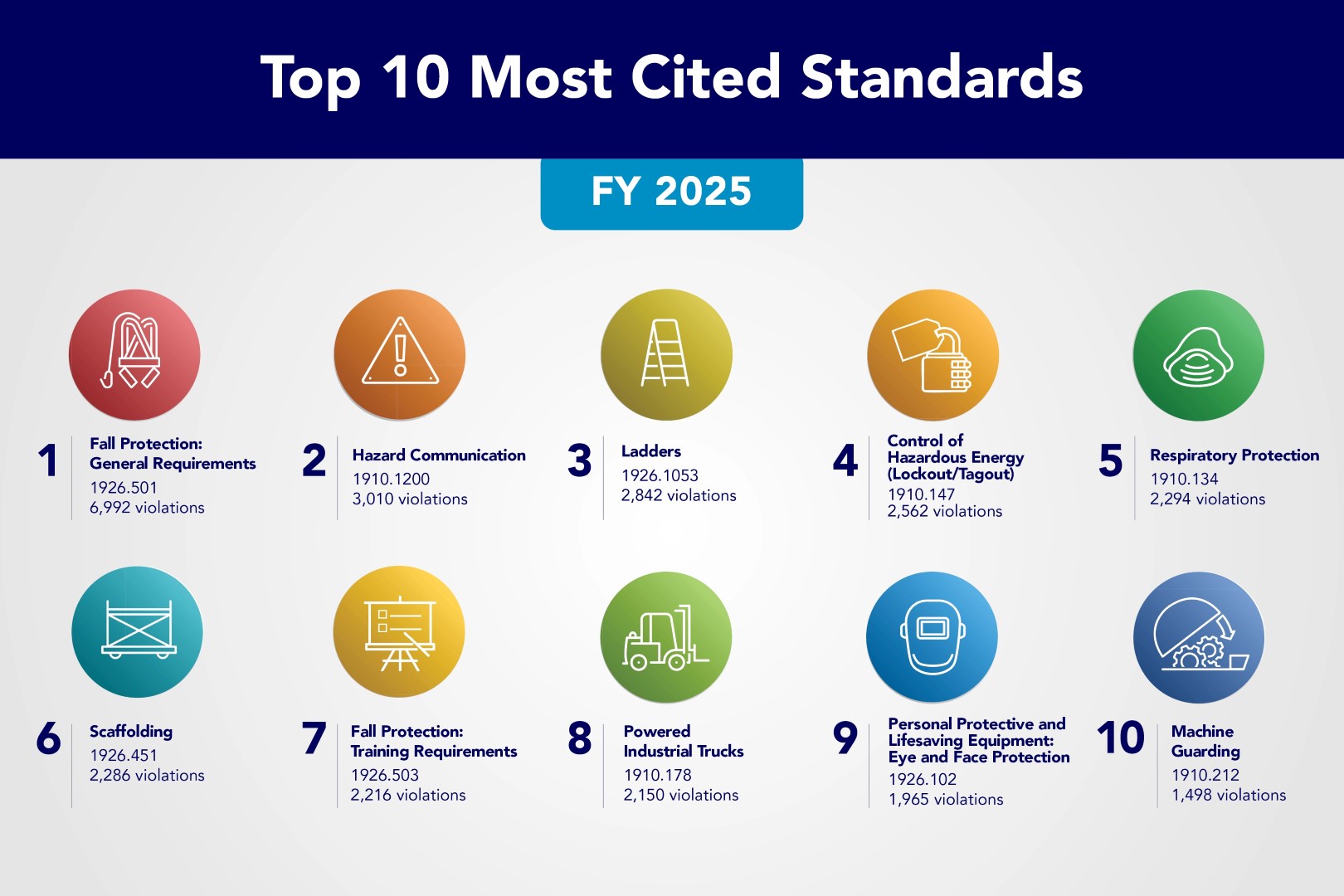
OSHA's FY 2025 Top 10 Most Frequently Cited Violations - Includes illustrations symbolizing the top ten most frequently cited standards in the list on this page.
What are the OSHA fall protection requirements for the construction industry?
The OSHA fall protection requirements aim to protect employees from fall hazards by enforcing standards that require employers to evaluate working surfaces, provide appropriate fall protection systems, and train workers on safe practices.
Related Reading:
Stop risking your site’s safety record on unvetted partners. Read our complete breakdown in The Ultimate Guide to Contractor Prequalification.
Fall protection is required in the construction industry whenever employees are working at heights of 6 feet or more above a lower level. This includes work on low slope roofs, leading edges, floor openings, scaffolding (at 10 feet or more), steel erection (at 15 feet or more), fixed ladders, portable ladders, aerial lifts, and other walking-working surfaces where there is a risk of falling.
In construction sites, OSHA mandates that fall protection must be provided when workers are exposed to fall hazards at heights of 6 feet or more above a lower level.
💡 Did You Know?
While construction establishes a 6-foot trigger height, General Industry regulations (29 CFR 1910) generally set the trigger height lower, at 4 feet.
Under 29 CFR 1926 Subpart M, employers must implement a fall protection plan that includes personal fall protection systems such as full-body harnesses, positioning device systems, guardrail systems, safety net systems, or personal fall arrest systems (PFAS) to prevent falls.
Who Pays the Price for Fall Risks? Contractor Liability & Accountability
In this high-stakes environment, manual lookups or skipping background checks on a vendor's OSHA history is a major risk. When a primary company outsources labor, it is inheriting that subcontractor's regulatory history. In the eyes of insurers and the legal system, these companies effectively become the owner of that risk profile the moment subcontractors step onto the jobsite.
Deep Dive: Want to build a stronger overall safety culture beyond just fall protection? Explore Understanding Safety Compliance: Key Concepts and Effective Strategies.
Hiring a vendor with a history of willful or repeat citations can trigger stop-work orders and cause a sudden, devastating spike in your own EMR. A single $265,000 fine in your supply chain can disrupt project timelines and skyrocket your premiums for years to point where you are no longer competitive.
Both prime contractors and subcontractors share job site liability under OSHA's Multi-Employer Citation Policy. Relying on written rules without field enforcement commonly results in heavy penalties, as willful or repeated violations carry maximum fines exceeding $165,514 per infraction.
🛡️ Risk Pro-Tip:
By pairing historical OSHA enforcement trends with specific site activities, modern third-party risk software can model the financial risk of using high-risk contractors, helping compliance officers justify stricter safety mandates to leadership.
The Three Phases of an OSHA Inspection
An OSHA inspection follows a standard process, consisting of three phases. When a compliance officer arrives at your construction site, an OSHA inspection follows a standard process, consisting of three distinct phases. Understanding this sequence is critical for contractors looking to minimize liability and demonstrate a culture of safety.
1. The Opening Conference
The inspection officially begins when the OSHA Compliance Safety and Health Officer (CSHO) arrives at the job site and presents their official photo credentials. During this initial stage, the inspector will explain why the facility was selected (e.g., a random programmed inspection, a targeted hazard sweep, an employee complaint, or a severe injury referral).
Read more:
General rules don't apply to every job site. Learn how to navigate complex requirements in OSHA and Workplace Safety: Industry-Specific Standards Explained.
2. The Walkaround
The second and most critical phase is the site walkaround. The compliance officer will tour the construction site alongside employer and employee representatives to identify safety hazards. They will closely inspect active work zones to ensure all passive safety systems (like guardrails) are secure and that workers are properly using their personal protective equipment (PPE), including harnesses, lanyards, and anchorages.
The CSHO will pull aside employees for brief, private interviews to gauge the daily safety culture. They will also inspect mandatory safety logs, specifically the OSHA 300 logs tracking injuries and illnesses. It is crucial at this point to have documentation proving your workers possess up-to-date fall protection certification, demonstrating they have been formally trained to recognize and navigate height-related hazards.
3. The Closing Conference
After gathering all field evidence, the inspector holds a final meeting with the employer and employee representatives. In this final phase, the inspector discusses their findings with the prime contractor and relevant subcontractors. They will point out any observed violations, recommend corrective actions, and explain potential fines before any official citations are mailed. The CSHO details the employer's rights, the process for contesting citations, and potential remediation timeframes.
💡 Did You Know?
By law, OSHA has up to six months following the inspection to issue official citations and proposed financial penalties.
Being prepared for these three phases ensures that when an inspection occurs, your job site is ready to demonstrate total compliance.
Recent Cal/OSHA Updates on Fall Protection Requirements
Cal/OSHA’s fall protection regulations underwent a major shift following amendments that took effect on July 1, 2025. All residential construction and framing contractors in California must now adapt to a fall protection trigger height of six feet, replacing the state's historical 15-foot allowance and officially aligning California with federal OSHA standards.
However, California's framework still features unique regional differences:
- Where Cal/OSHA is more lenient: For non-residential roofing, California's trigger height remains at 20 feet, and standard guardrails are not required until 7.5 feet—both of which are technically higher than the federal 6-foot threshold.
- Where Cal/OSHA is stricter: California implements aggressive rules based on roof pitch and equipment types. Any roof with a steep slope exceeding a 7:12 pitch requires fall protection regardless of height, and traditional field workarounds like slide guards or roof jacks are strictly banned.
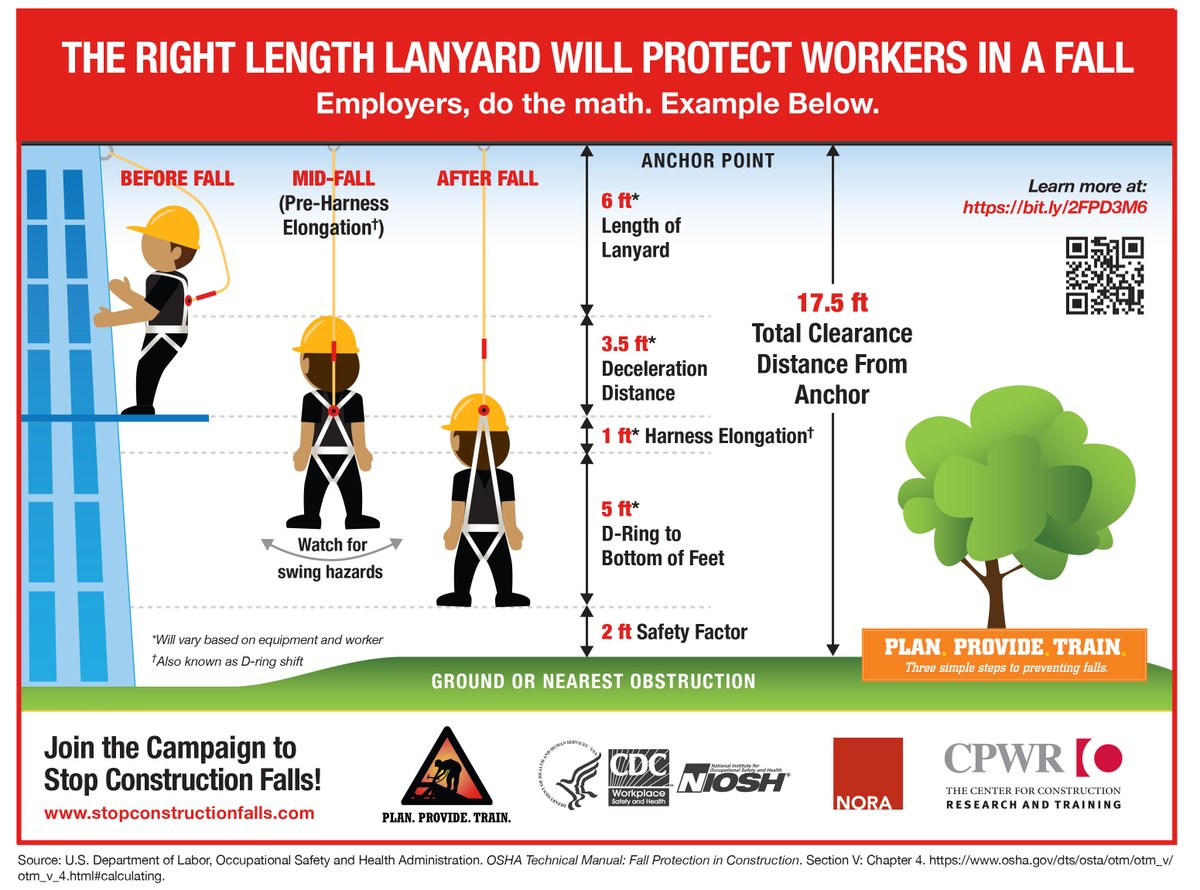
Source: Post on X retrieved from Roofers Union (X/@roofersunion)
The High Price of Height Hazards: Lessons from the Real-World Case
Many contractors view safety citations as isolated, "one-off" events. The enforcement action against Chicago-area residential contractor Martin Araujo (doing business as Araujo Construction Corp.) serves as a definitive debunking of that myth.
An OSHA enforcement action issued on September 16, 2026, against Chicago-area residential contractor Martin Araujo (doing business as Araujo Construction Corp.) serves as a stark warning of what happens when these standards are ignored.
During two separate investigations at Illinois job sites, OSHA inspectors discovered carpenters and laborers actively installing roof rafters and sheathing at heights of up to 25 feet without any fall protection systems in place. Exposing workers to heights—more than four times the federal 6-foot trigger height—resulted in OSHA issuing $265,868 in combined penalties.
This heavy fine was driven by two willful violations specifically for the lack of fall protection, compounded by nine repeat safety violations (including missing stairway handrails, inadequate head/eye protection, and unsafe ladders), a serious platform-access violation, and a lack of training certifications.
This was the contractor’s eighth safety violation in just four years. OSHA is no longer looking at individual incidents; they are penalizing a history of chronic non-compliance that signals a total breakdown in management systems.
Why OSHA Compliance Isn’t Enough to Mitigate Safety Liability
Simply meeting the baseline law is not enough to fully insulate an organization from legal and financial risk. A comprehensive, site-specific Fall Protection Plan ensures true liability mitigation by outlining designated competent person oversight, strict anchorage structural thresholds, and mandatory alternative engineering controls where conventional safety methods are infeasible. Primary contractors must aggressively address supply chain exposure through four distinct operational pillars:
- Automating the Vetting Pattern: Rather than relying on manual spreadsheets or gut feelings, risk managers should utilize systems that cross-reference public federal registries to flag a subcontractor's historical "willful" or "repeat" enforcement actions before onboarding is approved.
- Quantifying Risk in Dollars: Modern automated platforms do more than flag minor line items. They evaluate a subcontractor's historical data to calculate financial exposure—showing risk compliance officers how a severe penalty profile could trigger stop-work orders, disrupt project timelines, and skyrocket insurance premiums.
- Continuous Verification of Training: Because regulatory agencies frequently cite employers for a lack of documented safety certifications, primary contractors must implement strict access protocols. Field management should ensure that site access is withheld from external crews until verified, up-to-date fall-arrest and ladder safety credentials have been uploaded directly into the system.
- Rigorous Site-Level Enforcement: Contractor prequalification is entirely useless without daily field accountability. Once a subcontractor is approved for a project, their active work zones must be aggressively audited against the plan's core physical requirements.
Discover additional strategies for mitigating contractor liability and avoiding OSHA citations on the Parakeet Risk Blog.
Building an Efficient Fall Protection Plan
Mitigating OSHA liability requires a comprehensive, written Fall Protection Plan that goes beyond basic compliance and proactively addresses workplace hazards. To transform a written policy into real-world protection, a company’s active field operations should enforce these critical safeguards:
- Comprehensive Hazard Identification: Conduct and document regular site assessments to locate elevated risks, unprotected edges (6+ feet in construction, 4+ feet in general industry), and unguarded floor holes.
- The Hierarchy of Controls: Prioritize physical hazard elimination, passive controls (guardrails, hatch covers), and active fall restraint before relying entirely on personal fall arrest systems (PFAS).
- Equipment Inspection & Maintenance: Mandate strict visual gear checks before every shift, and immediately tag out and destroy damaged harnesses, lanyards, or anchors.
- Documented Worker Training: Train all exposed employees on equipment use, inspection, and hazard recognition, while maintaining clear, audit-ready records of completion.
- Prompt Emergency Rescue Protocols: Establish a formal, written rescue plan per OSHA 29 CFR 1926.502(d)(20) to ensure suspended workers are safely retrieved immediately after a fall to prevent life-threatening suspension trauma.
- General Duty Awareness: Remain vigilant that OSHA's General Duty Clause holds employers legally responsible for obvious or recognized hazards even when no specific, niche regulatory standard exists.
Stop leaving your OSHA compliance to chance! Protect your crew and your margins by proactively managing site safety. Book a Parakeet Risk demo to learn how we help contractors mitigate liability and stay inspection-ready.
Key Takeaways:
- The Severity of the Issue: Fall protection (29 CFR 1926.501) has been OSHA’s #1 most frequently cited violation for 15 consecutive years. Falls accounted for 865 of the 5,486 workplace fatalities in 2022.
- Regulatory Thresholds: In construction, OSHA mandates fall protection at heights of 6 feet or more (compared to 4 feet for general industry). Employers must use systems like guardrails, safety nets, or Personal Fall Arrest Systems (PFAS).
- Shared Liability: The most critical point for hiring companies is OSHA's Multi-Employer Citation Policy. Prime contractors inherit the risk of their subcontractors. If a vendor commits a willful violation, the prime contractor can face fines exceeding $165,000 per infraction, work stoppages, and skyrocketing insurance premiums (EMR).
- Inspection Readiness: It outlines the three phases of an OSHA inspection—the Opening Conference, the Walkaround (where private employee interviews and PPE checks happen), and the Closing Conference.
Sources & References
- DuraLabel. (n.d.). Guidelines for OSHA's Fall Protection Standards Compliance.
- Edge Fall Protection. (2026). Cal/OSHA's Changing Fall Protection Requirements: 2026 Guide.
- FallTech. (n.d.). Cal/OSHA Lowers Fall Protection Height for Residential Work: How to Stay Compliant.
- MENA Report. (2023). NIST Gaithersburg And Boulder Campuses OSHA Fall Protection Survey.
- Occupational Safety and Health Administration (OSHA). Fall Protection in Construction (Publication 3755). U.S. Department of Labor.
- Occupational Safety and Health Administration (OSHA). Top 10 Most Frequently Cited Standards. U.S. Department of Labor.
- Roofing Contractor. (n.d.). OSHA Hits Contractor with $265K Fine for Roof Fall Hazards.
Frequently asked questions
How long is a fall protection training license valid?
A fall protection training license lasts for 2 years, after which renewal or retraining may be required to ensure ongoing compliance and safety awareness.
What are the formats available for fall protection training?
Fall protection training can be conducted either online or in-person, providing flexibility for workers and employers to choose the most suitable method for their needs.
What is the required height for guardrail systems according to OSHA?
Guardrail systems must be 42 inches high, with an allowable variation of plus or minus 3 inches, to ensure adequate fall protection.
How many fall protection violations did OSHA report in the past?
OSHA reported 7,188 fall protection violations in 2023, highlighting the ongoing challenge of compliance in workplace safety. Between October 2020 and August 2021, OSHA recorded 5,271 citations for fall protection, maintaining its status as the agency’s top workplace violation for the eleventh year in a row.

Written by
The Parakeet TeamField notes from the people building continuous risk engineering for industrial operations.