In this article
A machine stops on a Toyota line. The first answer is plain enough. There was an overload, and the fuse blew.
Taiichi Ohno, who built the Toyota Production System, refused to leave it there. Why was there an overload? The bearing was not sufficiently lubricated. Why? The lubrication pump was not pumping sufficiently. Why? The pump shaft was worn and rattling. Why was the shaft worn? There was no strainer attached, and metal scrap got in. [1]Replace the fuse and the line runs again for a few months. Then it stopped again, for a reason nobody fixed. The habit did not start with Ohno, and it did not stay on his line.
A loom that stopped itself
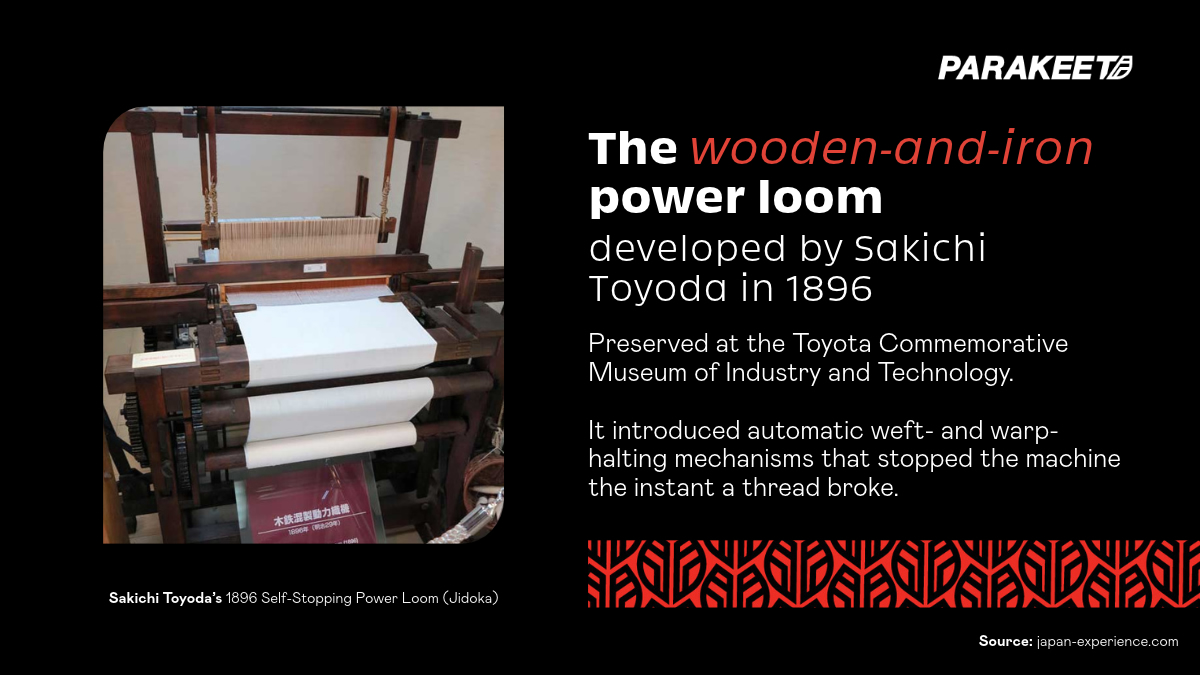
Sakichi Toyoda received recognition from the American Society for Quality. His loom company became Toyota Industries. [2] In 1896, one of his power looms could stop itself when a thread broke. The cloth stayed clean because the machine stopped instead of continuing to weave with the broken thread. Toyota's own history treats that self-stopping loom as the start of jidoka. [3]The discipline version is Ohno's. He wrote it down in Toyota Production System in 1978, in one line:
The basis of Toyota's scientific approach is to ask why five times. [4]
Five is the count from his machine example, the depth it took to get from a blown fuse to a missing strainer. Nobody at Toyota treated the number as a rule.
The question leaves the factory
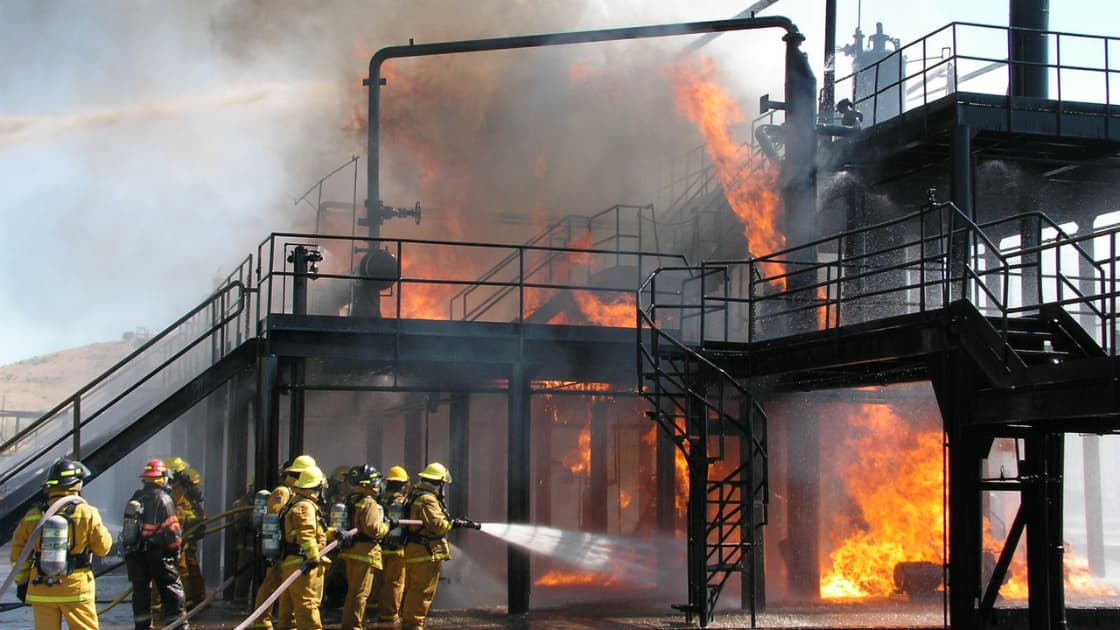
Process safety people met the same first answers in a different building. Risk engineering is loss control, and loss control gets billed in downtime before it gets billed in anything else. OSHA and the EPA define a root cause as a fundamental, underlying, system-related reason why an incident occurred, one that identifies a correctable system failure. Correct only the immediate cause, they warn, and you eliminate a symptom, not the problem. [5]
Their worked example is oil on a plant floor. Clean up the oil, tell people to be careful, and you are done in an hour. Ask why the oil was there, why it stayed, whether it was reported, and the answer was a mechanical integrity program that did not prevent, identify, or correct leaks. [6]
What the first answer cost
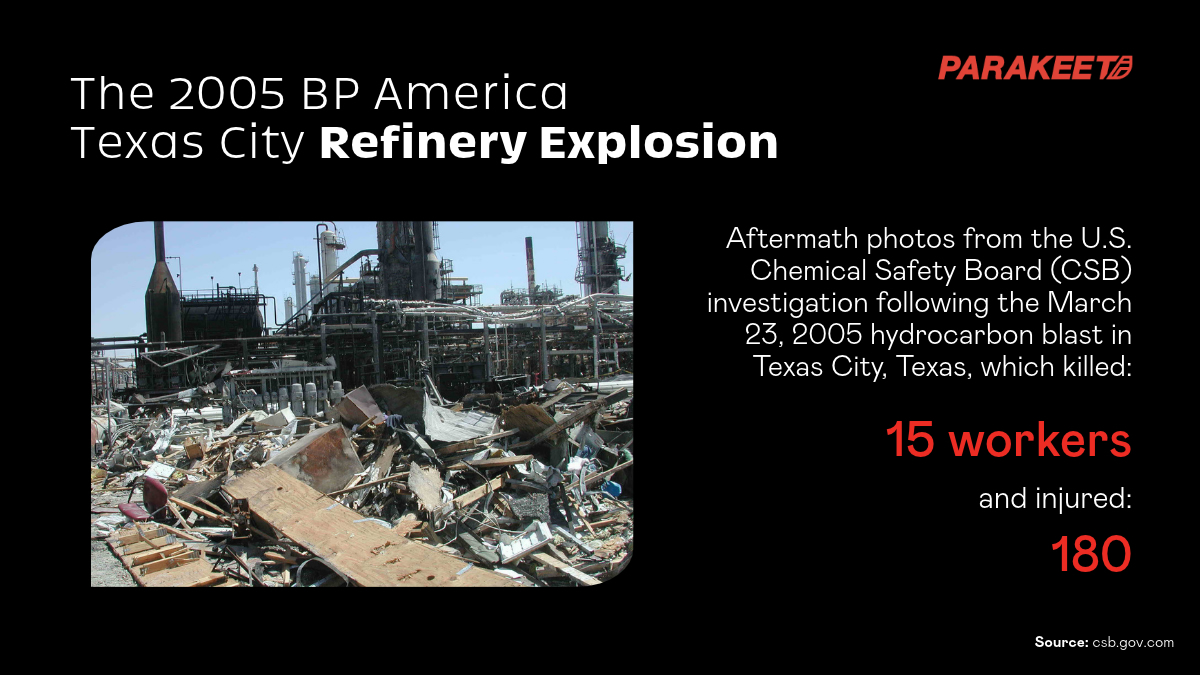
On March 23, 2005, an explosion at the BP refinery in Texas City killed 15 people and injured 180. The Chemical Safety Board concluded that organizational and safety deficiencies at all levels of BP caused it, after earlier investigations at the site had too often settled on operator error. Cost-cutting, production pressure, and poor training for abnormal startups underpinned the errors made that morning. [7]
The story everyone tells
Trainers in the United States tell it about the Jefferson Memorial. The stone was deteriorating, and the first why landed on the washing: the memorial was cleaned so often because of the bird droppings, and the birds came for the spiders, and the spiders for the midges. The midges swarmed at dusk because the floodlights came on before dark and drew them in off the Potomac. The fix the trainers celebrate is turning the lights on an hour later.
Joel Gross checked the story in 2014 and tracked it back to an unpublished 1993 study by entomologist Don Messersmith for the National Park Service. It covered the Lincoln Memorial too. Cleaning was one contributor among several, including acid rain and water seepage, and the water volume did more damage than the chemicals. In a six-week pilot in 1990, turning the lights on an hour after sunset cut midge counts by 85 percent. The change was never kept: photographers complained about losing the sunset shot, and by 1995 it was off the table. Restoring the two memorials took more than five years and cost about $25 million. [8] The training version leaves most of that record out.
Where the chain breaks
Alan Card, writing in BMJ Quality and Safety in 2017, thinks the method should mostly be retired to the classroom. [9] His objection is mechanical. A single chain cannot carry a failure that had four causes, and stopping at the fifth why proves nothing except that you can count. Teruyuki Minoura, who ran global purchasing at Toyota, had said much the same:
too basic for the analysis a real fix needs.
Card is right about major incidents. The Center for Chemical Process Safety guidelines for investigating process incidents do not stop at five questions. They build timelines and event trees, because a fatal release has more causes than one chain holds. [10]
Start asking Why. Let Rosella draft your first five steps.
Toyota, 1978A machine stops on the line. The first answer is plain enough: there was an overload, and the fuse blew.
Five whys: the blown fuse
Checking is where most chains actually die, at an answer somebody wrote down without verifying it. The Art of Lean version of the method insists on facts gathered where the work happens, and on reading the chain backward with therefore between the links:
- No strainer, therefore scrap in the pump.
- A rattling shaft, therefore too little oil.
- A dry bearing, therefore the overload that blew the fuse.[11]
A link that will not survive the backward reading is where the work restarts, out at the machine. And a chain that ends with a careless operator has stopped one question early:
What made the careless act possible on that job, with that equipment?
The chain, kept in Rosella
Rosella is where we built it. The 5 Whys lives in the same chat an engineer uses for everything else in Rosella, starting from the incident or the risk register item already on screen. Before drafting any chain, the engineer attaches the evidence: register records and SOPs, or a file off the job. Rosella returns three draft chains, five whys deep. The engineer picks the least wrong one and starts editing.
Each step is labeled by origin. If the model drafted a step and an engineer rewrote it, the step says so, and it still says so twelve revisions later. The stale rule was deliberate: edit an early step and Rosella recalculates only its own steps underneath, while a step a person wrote gets marked stale and left alone. Erasing an engineer's corrections is the fastest way to make engineers stop correcting.
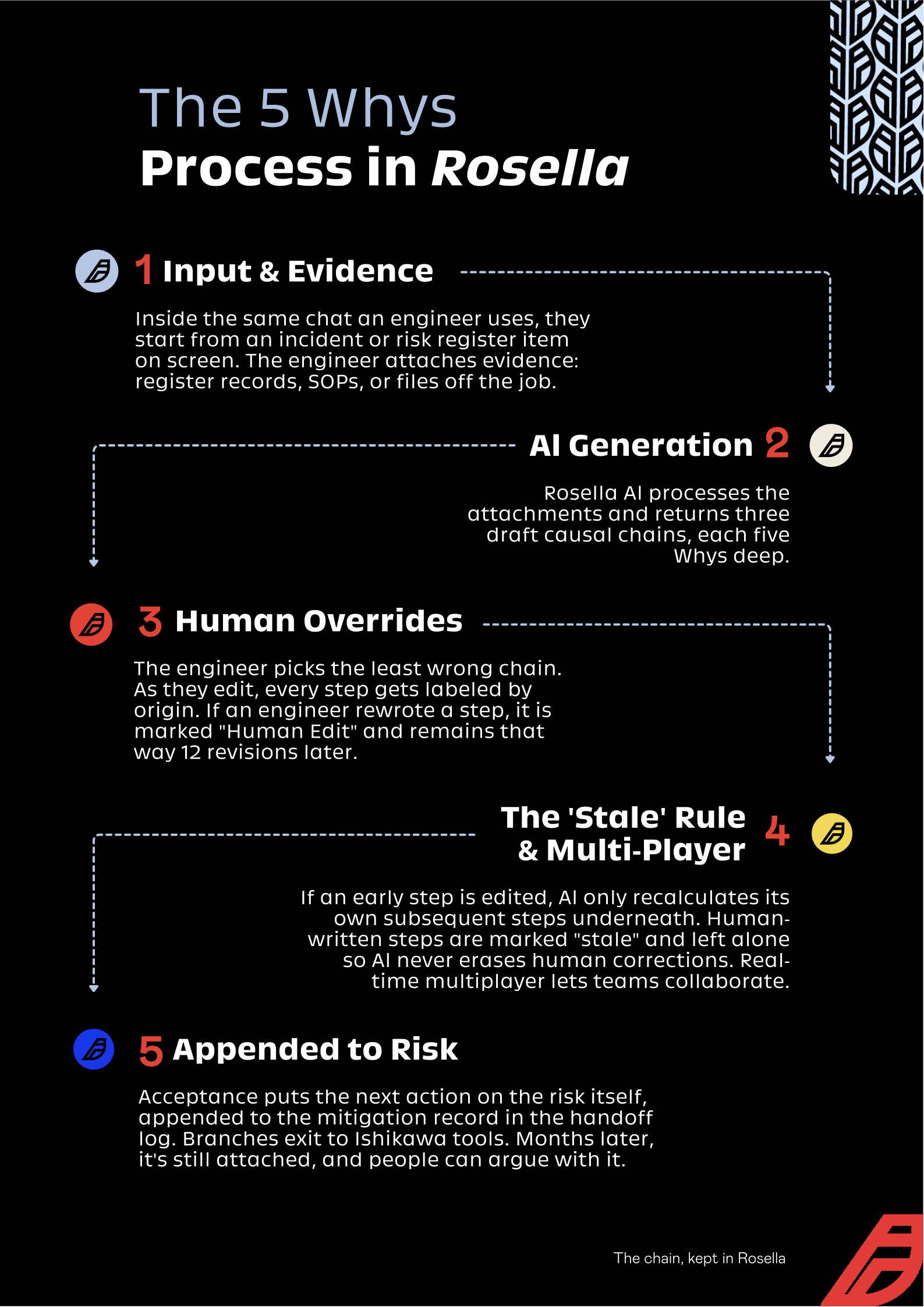
Revisions accumulate, each with the evidence snapshot it used, and in multiplayer several people can be in the same chain at once. When an engineer accepts a chain, it does not sit in the chat. Its next action goes onto the risk itself, appended to the mitigation record, with the artifact revision noted in the handoff log. Branching problems leave the flow entirely; the Ishikawa tools take those. Months later, someone opening that risk finds the chain still attached, and can argue with it.
If your root-cause analyses currently end up buried in slide decks or chat threads, we can show you how Rosella builds 5 Whys directly onto your risk register—with every human edit preserved.
References
1. Taiichi Ohno, Toyota Production System: Beyond Large-Scale Production (Diamond, 1978; English ed., Productivity Press, 1988), p. 17 for the stopped machine example and p. 123 for "the basis of Toyota's scientific approach is to ask why five times," as quoted in Alan J. Card, "The problem with '5 whys'," BMJ Quality & Safety 26, no. 8 (2017): 671-677. https://qualitysafety.bmj.com/content/26/8/671
2. American Society for Quality, "Five Whys and Five Hows," Quality Glossary. "The technique was originally developed by Sakichi Toyoda." https://asq.org/quality-resources/five-whys
3. Toyota Motor Corporation, "75 Years of Toyota," on Sakichi Toyoda's loom halting devices as the origin of jidoka. https://www.toyota-global.com/company/history_of_toyota/75years/text/taking_on_the_automotive_business/chapter1/section1/item4.html
4. Taiichi Ohno, Toyota Production System (1988), p. 123, as quoted in Card (2017).
5. Occupational Safety and Health Administration and Environmental Protection Agency, "The Importance of Root Cause Analysis During Incident Investigation," Fact Sheet OSHA 3895 (October 2016). Definition of root cause and the warning on correcting only the immediate cause. https://www.osha.gov/sites/default/files/publications/OSHA3895.pdf
6. OSHA and EPA, Fact Sheet OSHA 3895 (2016). Oil on the floor example, in which the root cause was a mechanical integrity program that did not prevent, identify, or correct leaks.
7. U.S. Chemical Safety and Hazard Investigation Board, Final Investigation Report, BP Texas City Refinery Explosion (March 2007), and CSB news release, March 20, 2007. https://www.csb.gov/u-s-chemical-safety-board-concludes-organizational-and-safety-deficiencies-at-all-levels-of-the-bp-corporation-caused-march-2005-texas-city-disaster-that-killed-15-injured-180/
8. Donald H. Messersmith, Lincoln Memorial Lighting and Midge Study, unpublished report prepared for the National Park Service, 1993 (CX-2000-1-0014), as investigated in Joel A. Gross, "5-Whys Folklore: The Truth Behind a Monumental Mystery," The Kai Zone, August 19, 2014, preserved at TapRoot. https://taproot.com/saved-post-5-whys-folklore-the-truth-behind-a-monumental-mystery/
9. Alan J. Card, "The problem with '5 whys'," BMJ Quality & Safety 26, no. 8 (2017): 671-677. doi:10.1136/bmjqs-2016-005849. Minoura criticism summarized in "Five whys," Wikipedia, citing Toyota sources.
10. Center for Chemical Process Safety, Guidelines for Investigating Chemical Process Incidents, 2nd ed. (2003), pp. 179-180, cited as a resource in OSHA Fact Sheet 3895.
11. Art of Lean, TPS Encyclopedia, "5-Why Analysis," on verified facts, going to the genba, and the reverse "therefore" test. https://artoflean.com/reference/five-why/

Written by
Jowanza JosephThe founder of Parakeet Risk, who reimagines industrial risk management by leveraging his deep experience in software engineering and data analytics.